

Currently Empty: $0.00


Blog
How Is a Scrutiny Assessment Completed? The Actual Process, Stage by Stage
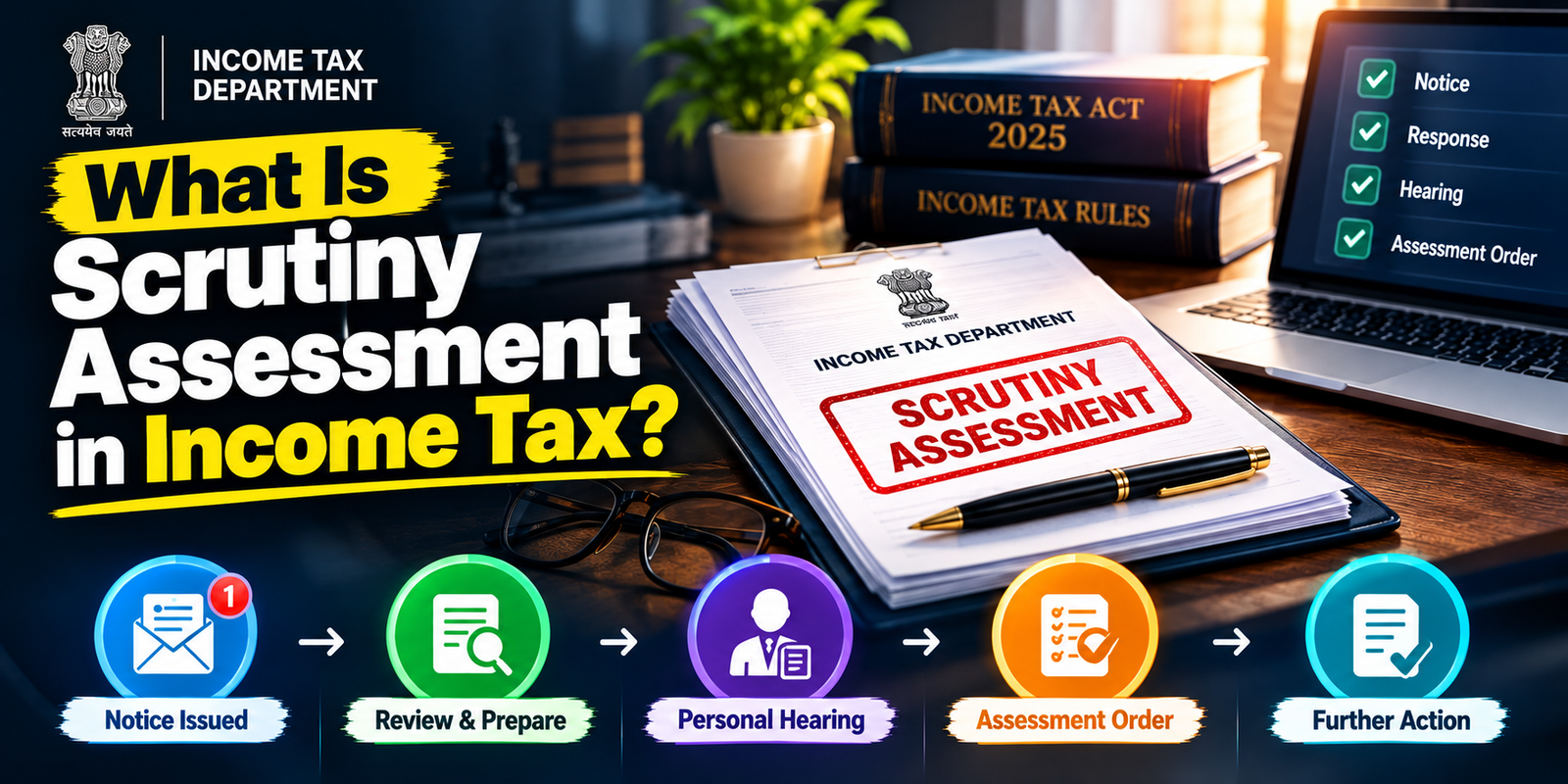
Getting a scrutiny notice is, honestly, the easy part. What decides whether you close the year with a clean assessment order or spend the next couple of years fighting a demand is everything that happens between that notice landing in your inbox and the final order being passed.
I want to walk through this the way I actually explain it to a client sitting across my desk with a notice in hand — as a sequence of stages, each of which either works for you or quietly works against you, rather than as a dry list of section numbers.
Stage One: Reading the Notice Correctly
Before you do anything else, work out exactly which notice you’ve received. A general inquiry notice asking for documents or an explanation of specific entries is issued under old Section 142(1), now Section 268 of the Income-tax Act, 2025. A formal scrutiny notice — the one that actually opens your return for detailed examination — is old Section 143(2), now Section 270(8)-(9). They look similar on the surface but carry different weight, and confusing one for the other is how people end up under-preparing their response.
Every valid notice carries a Document Identification Number, and you should verify it against the e-Proceedings tab on the income tax portal before you do anything else. A notice without a valid DIN, or one that doesn’t show up against your PAN on the portal, is worth flagging to your CA immediately rather than acting on.
Stage Two: Building Your Response File
This is where most cases are genuinely won or lost, and it has almost nothing to do with clever legal arguments. It’s about assembling a clean, complete, well-organised set of documents that answers exactly what’s been asked. Depending on what’s been flagged, you’ll typically need to keep the following ready:
- Bank statements for the full financial year, across every account you hold, not just the one where the flagged transaction sits.
- Books of accounts and ledger extracts relevant to the specific issue raised — cash book, sales register, purchase register.
- Invoices, contracts, and confirmations for any large transactions the officer has questioned.
- Loan confirmations that include the lender’s PAN and address, wherever unsecured loans or advances are involved.
- TDS certificates reconciled against Form 26AS and your AIS, especially where the mismatch itself was the trigger.
- Valuation reports, where property, unlisted shares, or any other asset transfer is part of the query.
- A short, dated cover note that answers each point raised in the notice, in the same order the notice raised it.
That last point matters more than people expect. A reply that dumps forty PDFs into the portal without a covering explanation makes the officer do the work of connecting your documents to their questions — and an officer doing that work on your behalf rarely does it in your favour. A short, point-by-point cover letter, even a page long, changes how your entire submission reads.
Stage Three: How Faceless Assessment Actually Runs
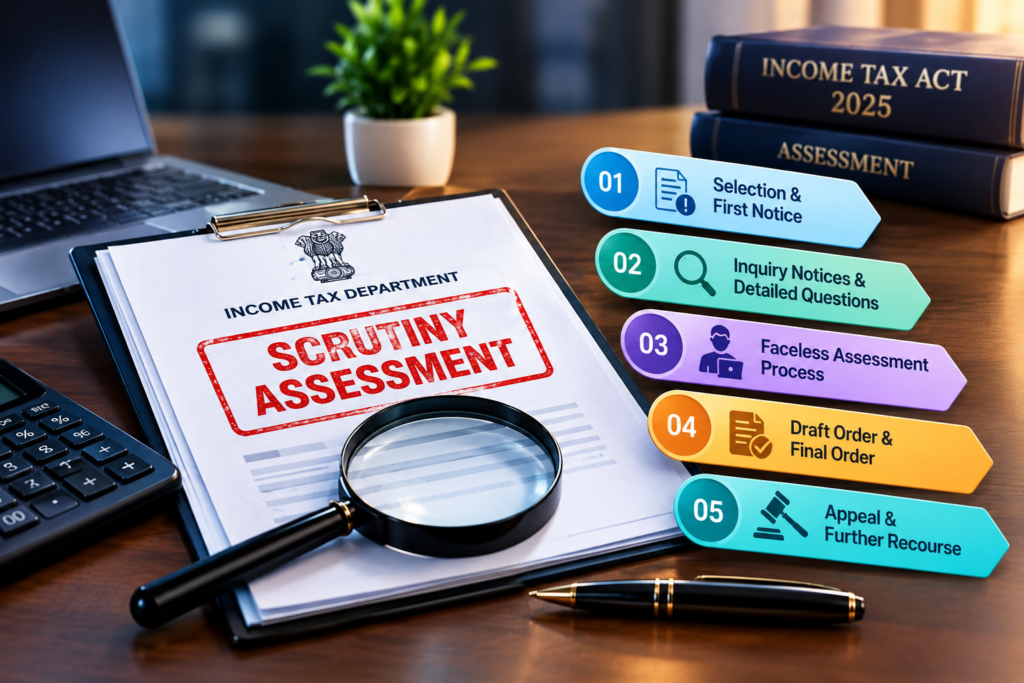
Almost all scrutiny assessments today move through the National Faceless Assessment Centre, under old Section 144B, now Section 273 of the 2025 Act. Your case gets assigned, algorithmically, to an assessment unit somewhere in the country that has no connection to your jurisdictional AO. All communication happens through the portal — there’s no face-to-face interaction as the default mode.
Where the assessment unit proposes a significant addition or variation, it first issues a draft order along with a show-cause notice, giving you a specified window to respond before anything is finalised. Courts have repeatedly insisted that this window has to be genuinely reasonable — a couple of days is not enough, and orders passed after cutting that opportunity short have been struck down on that basis alone. If you believe your case needs to be explained rather than just documented, you can request a personal hearing through video conference, and that request should be made explicitly rather than assumed.
We spend an entire module in the Income Tax Litigation Mastery course on drafting faceless-assessment submissions the way an assessment unit officer actually reads them, because a technically correct reply that’s badly structured can still lose the point on the screen.
Stage Four: The Draft Order and Your Last Chance to Respond
If you get a draft order and show-cause notice, treat it as your real opportunity to change the outcome — not a formality to acknowledge and move past. Respond to every addition proposed, attach anything you haven’t already submitted, and if the reasoning in the draft order misreads your earlier submission, say so plainly and point to exactly where your explanation was already on record. This is also the stage where, in appropriate cases, you can request that specific additions be dropped based on judicial precedent on similar facts — a well-chosen tribunal or High Court decision at this stage can sometimes do more than the same argument raised later in appeal.
Stage Five: The Final Order and the Deadline That Governs Everything
Once your response is considered, the Assessing Officer passes the final assessment order under Section 270(10)-(15) of the 2025 Act, corresponding to old Section 143(3). The outcome is one of three things: your returned income is accepted as is, an addition is made and a demand is raised, or in rarer cases, a refund position is confirmed or enhanced.
There’s a hard clock running on all of this. Under Section 286 of the 2025 Act — old Section 153 — a regular scrutiny assessment generally has to be completed within twelve months from the end of the relevant tax year. An order passed after that window closes is time-barred and void, regardless of how strong the department’s case might otherwise have been. I’ve used this deadline defensively more than once in practice, and it’s worth knowing even if you never need it.
Once the order is passed, if a demand is raised, you’ll receive a notice of demand — old Section 156, most likely renumbered as Section 289 under the 2025 Act, though I’d treat that specific renumbering as provisional until the final notified text is checked against your assessment year, since I could confirm it only against a single secondary source at the time of writing. From there, your options are to pay, to seek rectification of an apparent mistake under old Section 154 (now Section 287) if the error is clerical or computational, or to file a first appeal before the Commissioner (Appeals) — old Section 246A, now Sections 356/357 — within the prescribed time limit.
What the Officer Is Actually Weighing
It helps to remember that the assessment unit isn’t trying to catch you out on principle — it’s working through a checklist tied to whatever triggered the case, and it has its own deadline to meet under Section 286. An officer under time pressure, faced with a clean, well-indexed submission that directly answers the flagged issue, has very little reason to dig further. An officer faced with a vague or partial reply, on the other hand, has every reason to widen the inquiry, because an incomplete answer reads as something being withheld even when it isn’t.
This is also why timing your responses matters as much as their content. Filing at the last hour of the last day, especially in a faceless setup where the portal can be slow under load, leaves you no room if a document fails to upload or a query needs a quick clarification. I generally tell clients to treat the stated deadline as the date by which the submission should already be sitting complete on the portal, not the date to start assembling it.
A Pattern I See Often
A retail trader I worked with had a limited scrutiny case flagged purely on cash deposits during the festive season. We built the response around daily cash sale summaries reconciled with the till records and VAT/GST returns for the same period, filed it as a single organised submission rather than piecemeal replies, and requested a video-conference hearing to walk the officer through the reconciliation directly. The case closed with the returned income accepted, no addition, well within the statutory deadline. Nothing about that outcome depended on a clever legal argument — it came down entirely to a clean file and a response that answered the actual question being asked.
📘 Learn the Complete Scrutiny Assessment Process Practically
Want to handle scrutiny proceedings more systematically? The Income Tax Litigation Mastery Course (1961 + 2025 Act) takes you through the complete process—from the first notice and 268(1) questionnaire to replies, faceless proceedings, show-cause notices, hearings, and the final assessment order.It is designed for practical learning, with notice-wise handling, drafting approaches and templates for real-world scrutiny matters.
👉 Explore the course: https://courses.taxadvisory.in/
Frequently Asked Questions
How long does a scrutiny assessment take to complete?
The Assessing Officer generally has up to twelve months from the end of the relevant tax year to pass the order, under Section 286 of the 2025 Act (old Section 153). An order passed beyond this deadline is void.
Is a personal hearing possible in faceless assessment?
Yes. You can request a video-conference hearing in specified circumstances, particularly where you feel a written submission alone won’t adequately explain your position. The request needs to be made explicitly through the portal.
What documents should I keep ready for a scrutiny notice?
At minimum: full-year bank statements, relevant books of accounts, invoices or contracts for flagged transactions, loan confirmations, TDS reconciliations, and a point-by-point cover note addressing every query in the notice.
What happens if I disagree with the additions made in the final order?
You can file a first appeal before the Commissioner (Appeals) – old Section 246A, now Sections 356/357 of the 2025 Act – within the statutory time limit, or seek rectification first if the issue is a clear clerical or computational mistake.
Can the department reopen my case again after scrutiny is over?
Not on the same issue through scrutiny again, but reassessment remains possible later if the department has reason to believe income escaped assessment – that’s a separate proceeding under Section 279 of the 2025 Act (old Sections 147/148).