

Currently Empty: $0.00


Blog
Income Tax Appeal Before CIT(A): The First Appeal Process Explained Under the 2025 Act
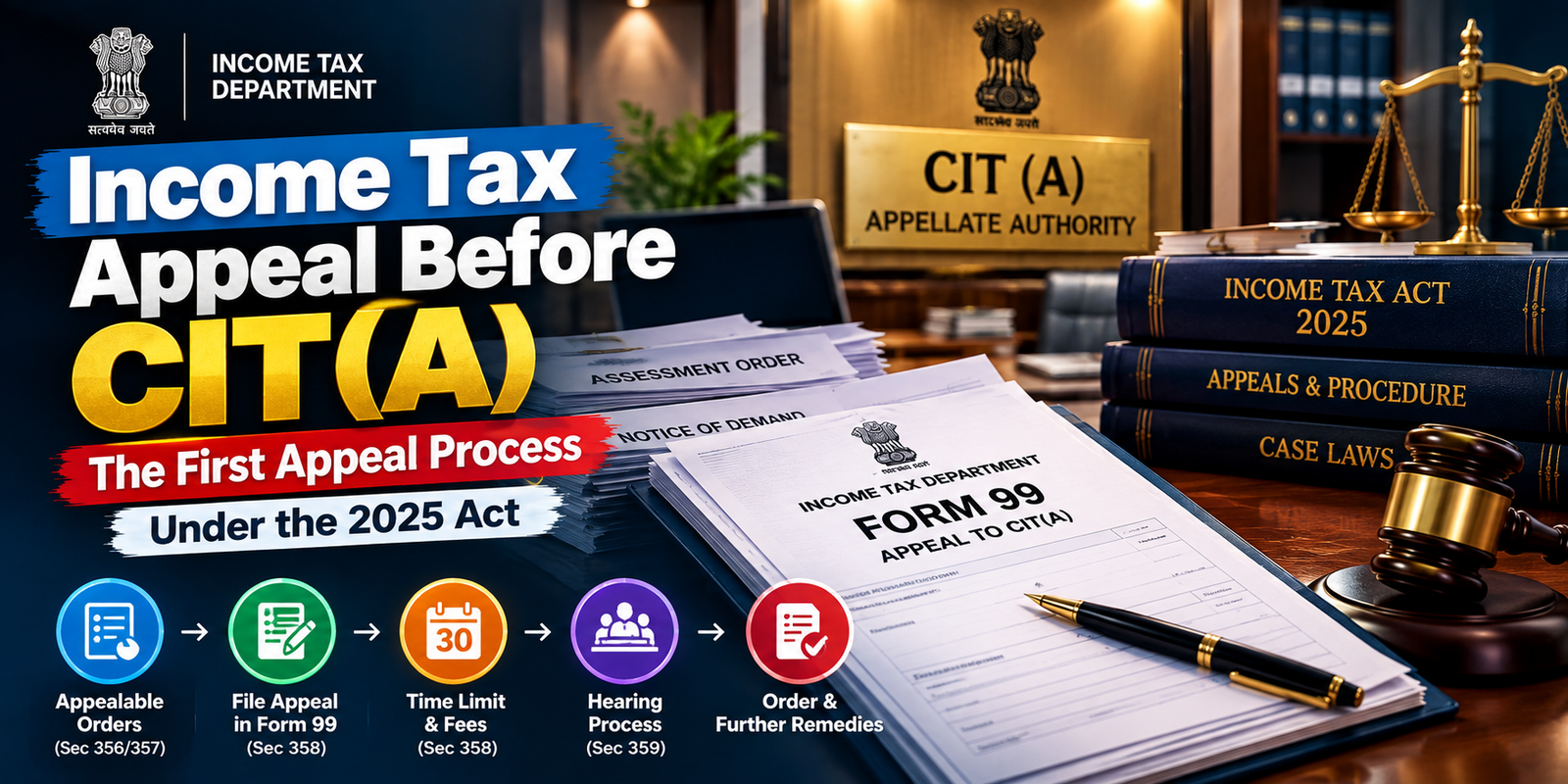
Every assessment order that lands badly for a client ends with the same question, asked in roughly the same tone of disbelief: “so what do we do now?” Usually what we do is appeal. It’s the most heavily used remedy in the entire litigation chain, and it’s also the one people get wrong in the most avoidable ways — missed deadlines, unpaid admitted tax, appeals filed without a stay application, grounds that don’t actually address the order. None of that has gotten any simpler with the renumbering under the Income-tax Act, 2025, so it’s worth going through the mechanics properly, once, rather than relearning them under pressure the week your client’s thirty days are running out.
What Orders You Can Even Appeal — Section 356/357 (old Section 246A)
Not every order the department passes against you is appealable to the first appellate authority. The Income-tax Act, 2025 lists appealable orders under Sections 356 and 357 (corresponding to old Section 246A) — and it also splits the forum by rank for the first time in a structural way. If the order was passed by an officer below the rank of Joint Commissioner, your appeal goes to the Joint Commissioner (Appeals). If it was passed by an officer of Joint Commissioner rank or above, or with the prior approval of someone above Deputy Commissioner rank, it generally isn’t appealable to this forum at all — your remedy lies elsewhere, typically revision or, in rare cases, a writ.
What’s actually appealable, broadly: intimations where you’ve disputed an adjustment, assessment and reassessment orders, orders giving effect to a higher authority’s directions, and most penalty orders. A client who comes to me assuming “any order I don’t like” can be appealed is usually surprised to learn that some orders — a rejection of a stay application, for instance — aren’t independently appealable under this provision at all; they’re challenged differently.
Filing the Appeal — Form 99, Time Limit and Fees Under Section 358 (old Section 249)
The appeal itself is filed in Form 99, which has replaced the familiar old Form 35. The structure of the form hasn’t changed dramatically — you’re still setting out grounds of appeal and a statement of facts — but the number has, and I’ve already seen drafts circulating among smaller practices that still cite Form 35, which is simply wrong for anything filed under the new Act.
The time limit under Section 358 is 30 days — from the date you’re served with the notice of demand, where there is one, or from the date the order itself is served, in other cases. That window is tight by design. Delay can be condoned on sufficient cause, but “my accountant was travelling” has never impressed an appellate authority and it isn’t going to start now; keep the explanation specific and documented if you genuinely need condonation.
There’s a precondition that trips people up more than the deadline does: Section 358 requires that tax on your returned income — the amount you yourself admitted in your own return — be paid before the appeal is entertained. This is separate from the disputed addition the Assessing Officer has made. I’ve had appeals sit in limbo, flagged as defective, purely because this admitted-tax payment wasn’t cleared before filing. Check this before you file, not after.
The appeal fee is slab-based: Rs 250 where the assessed income is up to Rs 1 lakh, Rs 500 between Rs 1 lakh and Rs 2 lakh, and Rs 1,000 where assessed income exceeds Rs 2 lakh, with a flat Rs 250 for appeals that don’t involve a quantified income figure at all — a penalty order with no fresh income determination, for example. It’s a small amount in absolute terms, but a wrongly calculated fee is still a technical defect, and I’d rather clients pay the correct slab the first time than have it flagged later.
What Happens After You File — Procedure Under Section 359 (old Section 250)
Once the appeal is filed, the appellate authority fixes a date and place for hearing and gives notice to both you and the Assessing Officer. Either side can appear in person or through an authorised representative. You can raise additional grounds of appeal that weren’t in your original memo, if the appellate authority is satisfied the omission wasn’t deliberate — something worth remembering if a stronger legal argument occurs to you after filing.
Additional evidence is a different story and a tighter one. Under the new Rule 192 of the draft Income-tax Rules, 2026 (replacing the old Rule 46A), you can generally only bring in fresh evidence at this stage if the Assessing Officer refused to admit it, you weren’t given a fair opportunity to produce it earlier, or you can show sufficient cause for not having produced it during the original assessment. I’d flag this specific rule number as reported in secondary commentary rather than confirmed against the final notified Rules — worth a quick re-check against the current text before you cite it in a formal submission, since the Rules were still being finalised in places as of this writing.
The order itself has to be in writing, stating the points for determination, the decision, and the reasons — a bare “appeal dismissed” doesn’t meet this bar and is challengeable on that ground alone. Appeals are meant to be disposed of within a year of filing where feasible, though this timeline is more of an administrative target than something you can enforce as a hard right.
The Power to Enhance — Section 360 (old Section 251)
This is the part clients sometimes forget when they’re deciding whether an appeal is worth the trouble: the first appellate authority doesn’t just have the power to confirm or reduce an addition. Under Section 360, it can also enhance the assessment — add to it, in other words — or, for a penalty order, confirm, cancel, or increase or reduce it. The one real constraint, carried forward from the post-2001 position under the old Section 251, is that the authority generally can’t set aside the matter and send it back to the Assessing Officer for a fresh decision; it has to decide the issue itself on the record before it. If enhancement is on the table, you’re legally entitled to a specific opportunity to be heard on that point before the order is passed — it can’t simply show up as a surprise in the final order.
This is exactly the kind of strategic call — whether to push an aggressive ground that risks inviting enhancement, versus a narrower, safer one — that comes up constantly in appeal drafting, and it’s one of the things we actually walk through case by case in the Income Tax Litigation Mastery course rather than just listing as a rule.
Filing an Appeal Doesn’t Stop Recovery — You Need a Separate Stay
This is probably the single most common misunderstanding I run into. Filing your Form 99 appeal does not, by itself, pause the department’s recovery action on the demand. If you don’t separately apply for a stay — either before the Assessing Officer or the appellate authority — you can genuinely find your bank account facing a recovery notice while your appeal is still pending merits.
The department’s long-standing administrative guidance is that paying 20% of the disputed demand ordinarily earns you a stay on the remaining 80% while the first appeal is pending. This isn’t a statutory entitlement carved in stone — it’s administrative instruction, and it can be argued down in genuine hardship cases, or up, in cases involving a high-pitched or clearly unsustainable addition. I’ve gotten this percentage reduced for clients where the addition itself was weak on the facts; don’t assume 20% is a fixed, non-negotiable number just because it’s the commonly quoted figure.
If You Lose — The Second Appeal to ITAT
An adverse order from the first appellate authority takes you to the Income Tax Appellate Tribunal, in Form 115 (replacing the old Form 36). The time limit has actually changed in a way worth noting: instead of the old flat 60 days from the date the order is communicated, the window is now two months from the end of the month in which the order is communicated. An order received on, say, 15 May effectively gives you until the end of July rather than mid-July — a small but genuinely useful extension in practice, and one I’d rather clients knew about than discovered by accident.
What About Appeals Already Pending Before 1 April 2026
If you had an appeal pending before the Income-tax Act, 2025 came into force, you don’t need to refile anything. Section 536(2)(e) of the new Act specifically provides that such pending appeals are to be disposed of as if the new Act had never been enacted — meaning the old Sections 246A, 249, 250 and 251 continue to govern that specific proceeding right through to its conclusion. The new Sections 356 to 360 apply to orders and appeals arising fresh, from 1 April 2026 onward.
Practical Mistakes Worth Avoiding
- Filing Form 99 before clearing the tax on your own returned income — this alone can get the appeal treated as defective.
- Assuming the appeal itself stops recovery proceedings. It doesn’t; file a stay application separately and promptly.
- Trying to introduce fresh documents at the appeal stage without any explanation for why they weren’t shown to the Assessing Officer — under Rule 192, you need a genuine reason, not just a better set of papers.
- Drafting grounds of appeal that are vague or repetitive rather than addressing the specific basis of the addition — generic grounds rarely move an appellate authority.
- Pushing for the maximum possible relief on a weak point when a narrower, well-evidenced ground would have a real chance — and risking enhancement in the process.
📘 Learn the Complete Scrutiny Assessment Process Practically
Want to handle scrutiny proceedings more systematically? The Income Tax Litigation Mastery Course (1961 + 2025 Act) takes you through the complete process—from the first notice and 268(1) questionnaire to replies, faceless proceedings, show-cause notices, hearings, and the final assessment order. It is designed for practical learning, with notice-wise handling, drafting approaches and templates for real-world scrutiny matters.
👉 Explore the course: https://courses.taxadvisory.in/
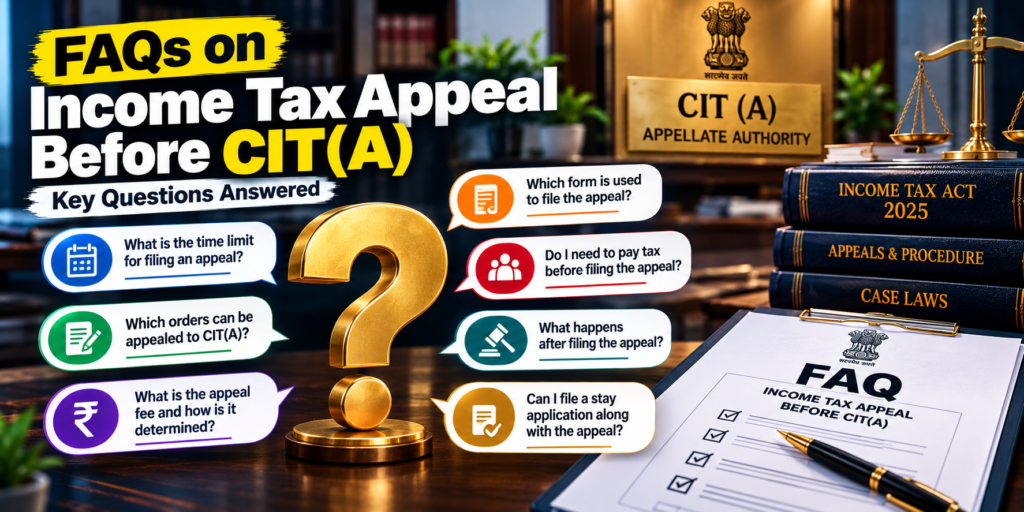
Frequently Asked Questions
What is Form 35 for income tax appeal — has it changed under the new Act?
Under the 1961 Act, first appeals to CIT(A) were filed in Form 35. Under the Income-tax Act 2025, the first appeal to the Joint Commissioner (Appeals) or Commissioner (Appeals) is filed in Form 99 instead. The underlying information required — grounds of appeal, statement of facts, the appeal fee — is largely the same; only the form number and a few procedural details have changed.
What is the time limit to file an appeal before CIT(A)/JCIT(A)?
30 days from the date you’re served with the order or demand notice you’re appealing against, under Section 358 (old Section 249). Delay can be condoned for sufficient cause, but don’t plan around that — file within the window.
Do I have to pay the full disputed tax before filing an appeal?
No — but you do have to pay tax on your returned income, meaning the amount you yourself admitted in your return, before the appeal is entertained. The disputed addition made by the Assessing Officer is handled separately, usually through a stay application.
Does filing an appeal automatically stop recovery proceedings?
No. Filing the appeal by itself doesn’t stay recovery. You need a separate stay application, and the department’s standing administrative practice is that paying 20% of the disputed demand ordinarily gets you a stay on the rest while the appeal is pending — though this figure isn’t a fixed statutory rule and can be negotiated in the right circumstances.
Can the CIT(A)/JCIT(A) increase my tax liability instead of reducing it?
Yes. The first appellate authority has the power to enhance an assessment under Section 360 (old Section 251), not just confirm or reduce it. But it must give you a specific opportunity to be heard on the proposed enhancement before passing that order — it can’t be a surprise.
One honest caveat before you rely on any of this for a live matter: the Section 356-360 mapping and the Rule 192 reference above are drawn from secondary commentary cross-checked across more than one source, since the Income-tax Rules, 2026 were still being finalised in parts at the time this was written. Confirm the exact section and rule numbers against the currently notified text before quoting them in any formal appeal submission.