

Currently Empty: $0.00


Blog
Documents Tax Officers Demand During Scrutiny: The Real Checklist Under the 2025 Act
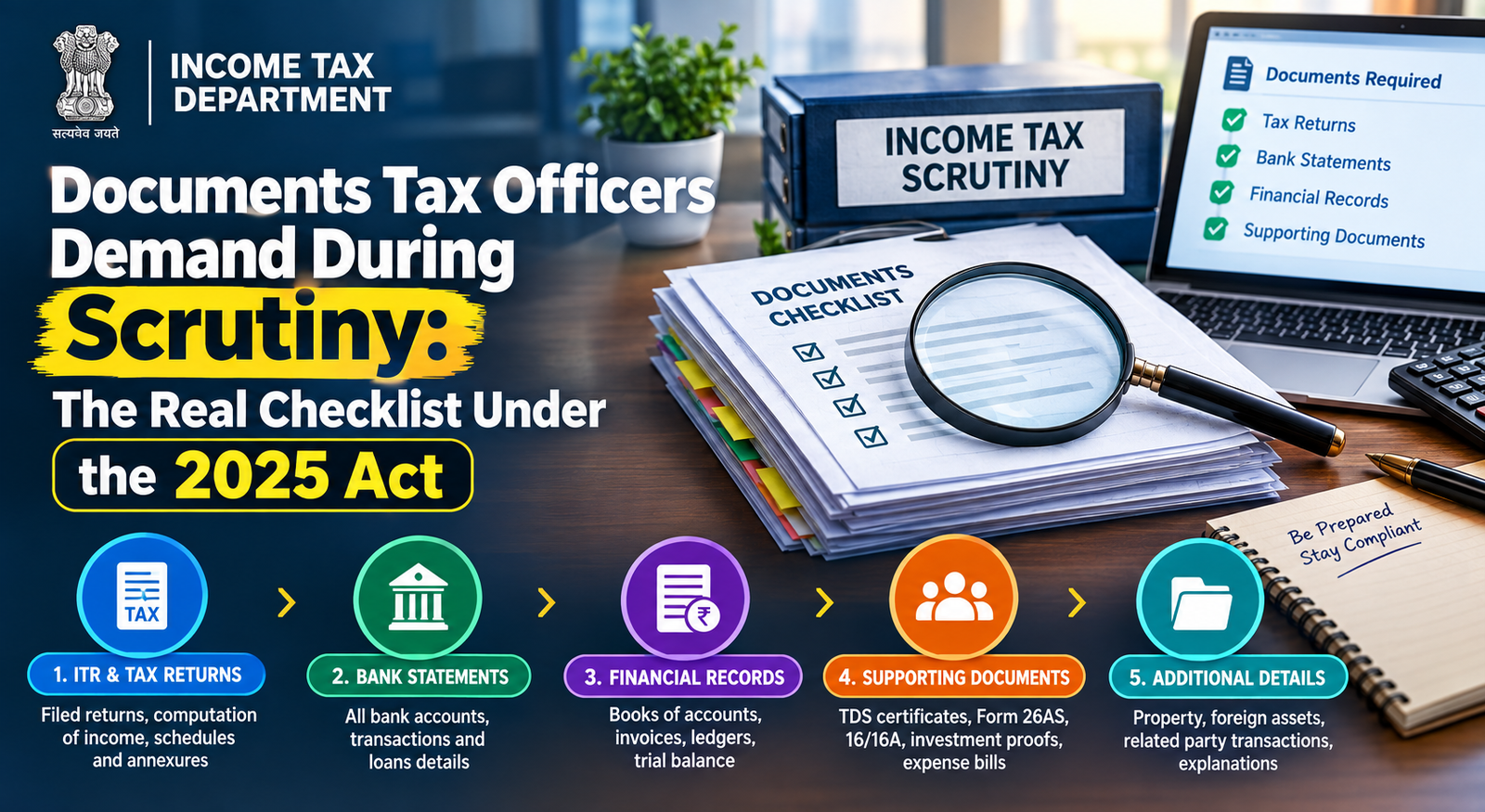
“Sir, ye sab documents kahan se laaun?” is a question I hear a lot, usually from someone staring at a notice with eleven numbered points, half of which are worded in language only a tax officer would write. The honest answer is that most of what’s demanded is stuff you already have somewhere – it’s just scattered across a bank locker, an old email, and a folder your accountant filed away three years ago. The trick is knowing in advance what’s likely to be asked, so you’re not digging through drawers with a compliance deadline ticking down.
This is a practical, experience-based list of what actually shows up in scrutiny requisitions under Section 268(1) of the Income-tax Act, 2025 – the section that carries forward the old Section 142(1) power to call for accounts, documents and information. I’ve grouped it by the kind of taxpayer you are, because a salaried person’s file and a business owner’s file get asked very different questions.
The Legal Basis: What Power Lets the Officer Ask for All This
Under the 1961 Act, this power sat in Section 142(1): the Assessing Officer could require a person to produce accounts or documents the officer thinks relevant, or to furnish information in writing on points the officer specifies, including a statement of assets and liabilities. Under the 2025 Act, this now sits in Section 268(1), with the same structure carried forward – notice for accounts and documents, notice for a written statement on specified matters, and a further sub-section (268(5), the successor to old Section 142(2A)) that lets the officer direct a special audit in more complex cases where the accounts are voluminous or the officer isn’t satisfied with their correctness.
There’s a built-in limit worth knowing: the officer generally can’t call for accounts relating to a period more than three years before the relevant assessment year, and calling for a full statement of assets and liabilities beyond what’s already disclosed requires the Joint Commissioner’s prior approval. That’s a genuine procedural safeguard, not a technicality – if a demand looks like it’s reaching further back than it should, or asking for a net-worth statement without that approval being on record, it’s worth pointing out in your reply rather than just complying silently.
For Salaried Taxpayers: What Actually Gets Asked
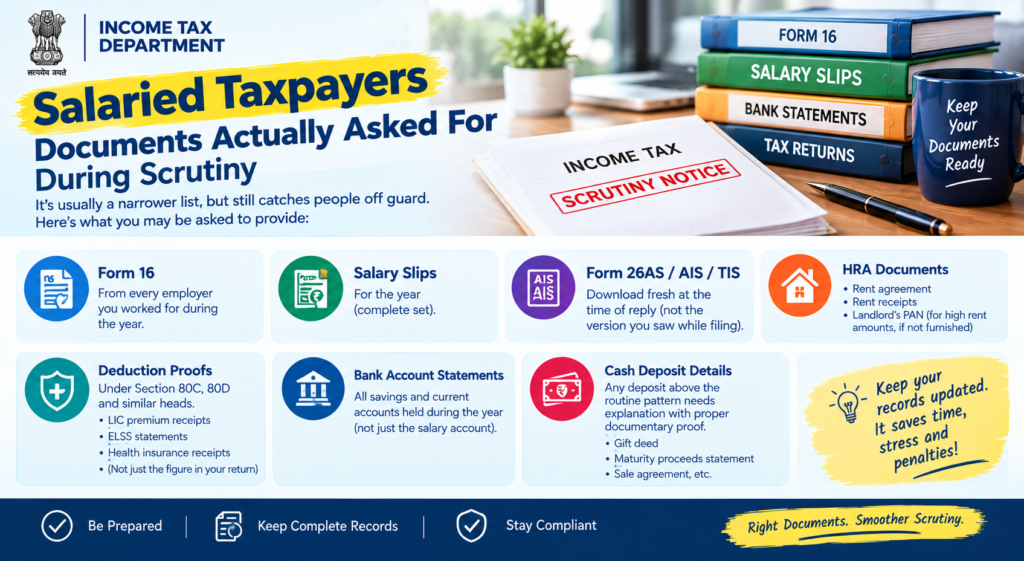
Salaried scrutiny is usually narrower but still catches people off guard. The standard list includes Form 16 from every employer you worked for during the year, salary slips, and Form 26AS/AIS/TIS reports downloaded fresh at the time of reply (not the version you looked at while filing, since these get updated). If you’ve claimed HRA, you’ll typically need the rent agreement and rent receipts, and if the landlord’s PAN wasn’t furnished for high rent amounts, expect a specific query on that. Deduction claims under Section 80C, 80D and similar heads need the actual proof – LIC premium receipts, ELSS statements, health insurance premium receipts, not just the figure typed into the return.
Where things get more detailed is around bank accounts. Officers increasingly ask for a full statement of all savings and current accounts held during the year, not just the one linked to your salary credit, because AIS data now captures interest income and high-value transactions across accounts you may have forgotten to mention. Any cash deposit above the routine pattern – a lump sum around a festival, a property transaction, a family event – draws a specific query, and you’ll want the source explained with a paper trail: a gift deed, a maturity proceeds statement, a sale agreement, whatever actually backs the number.
For Business and Professional Taxpayers: The Heavier List
Business scrutiny asks for a lot more, because there’s a lot more to verify. Expect to produce the full books of account – cash book, ledger, journal, and the bank book if maintained separately – along with purchase and sales registers, stock records where applicable, and the audit report in Form 3CA/3CB and 3CD if you’re subject to tax audit. GST returns (GSTR-1, GSTR-3B, and the annual return where filed) get cross-checked against your declared turnover, and any gap between GST turnover and ITR turnover is one of the most common triggers for a follow-up query, so have a reconciliation ready even before it’s asked for.
Expense claims need invoices, not just ledger entries – rent paid, professional fees, commission, any large single expense head gets tested against actual bills and, increasingly, against whether TDS was deducted correctly where applicable. Loan and unsecured loan confirmations are another frequent ask: if your balance sheet shows unsecured loans from directors, relatives or friends, be ready with confirmation letters, their PAN, their bank statement showing the amount actually going out, and their return acknowledging the loan given (or an explanation of their source, particularly if the amount is sizeable). This is one of the more litigated areas under Section 68 additions for unexplained cash credits, and a well-documented loan file at the scrutiny stage saves an enormous amount of trouble later.
A Short Example From Practice
A shop-owner client of mine got a query on a set of unsecured loans totalling about Rs 12 lakh from three relatives, shown as fresh credits in the year. We put together, for each lender, a one-page summary with their PAN, the bank transfer entry, their ITR acknowledgment for that year showing sufficient income, and a simple loan confirmation letter. All three were accepted without further question. Compare that to another case where a similar credit had no paper trail beyond a diary entry – that one ended up as an addition under Section 68, followed by a misreporting penalty notice. The documents genuinely make the difference; it’s rarely about whether the transaction was real, it’s about whether it’s provable on paper.
For Capital Gains and Property Transactions
If your return shows capital gains, be ready with the purchase deed and sale deed (or allotment letter and possession letter for under-construction property), the cost of acquisition and improvement with supporting bills, brokerage or stamp duty paid, and, for shares or mutual funds, the broker-issued capital gains statement or contract notes rather than a self-computed spreadsheet. Where you’ve claimed exemption under Section 54, 54F or similar, the officer will want proof that the new property was actually purchased or construction completed within the prescribed period – the sale deed of the new asset, or, if construction is ongoing, the payment schedule and builder correspondence showing the timeline.
How to Organise What You’re Submitting
The mistake I see most often isn’t a missing document – it’s a genuine document submitted in a way that doesn’t answer the question asked. If the notice has eleven numbered points, your reply should have eleven corresponding numbered responses, each with its own attachment named clearly (not “scan1.pdf”, “scan2.pdf” uploaded in random order). Officers reviewing these files – and under the faceless system, a different officer may pick up the file at each stage – work faster and more favourably through a submission that’s indexed and easy to follow. This kind of document organisation is exactly what we drill into in the Income Tax Litigation Mastery course, because it genuinely changes how quickly and cleanly a case closes.
what If You Can’t Find or Don’t Have a Document
Sometimes a document genuinely doesn’t exist anymore – an old loan confirmation, a rent receipt from years back, a bill for a small cash expense. Don’t manufacture something to fill the gap; that creates a much bigger problem than a missing document ever would. Instead, explain the gap honestly and support the claim with whatever secondary evidence exists – a bank entry, a third party’s confirmation, an affidavit where appropriate. Assessing Officers, faceless or otherwise, generally respond reasonably to a genuine, well-explained gap. What they don’t respond well to is a fabricated document that doesn’t hold up on a second look, which is a road to a misreporting penalty under Section 439 of the 2025 Act (old Section 270A) rather than a simple addition.
Want to Learn Income Tax Litigation Practically?
If you regularly handle scrutiny notices, assessments, replies, and tax litigation, our Income Tax Litigation Mastery Course is designed to help you understand the process practically under both the Income-tax Act, 1961 and the new Income-tax Act, 2025.The course covers practical scrutiny proceedings, notice-wise handling, drafting approaches, and real-world case handling so you can build a structured response strategy.
Explore & Enrol: https://courses.taxadvisory.in/
FAQs
What documents are needed to reply to a Section 142(1) / Section 268(1) notice?
It depends entirely on what the notice specifically asks for, but commonly needed items include Form 16/26AS/AIS, bank statements for all accounts, books of account and audit report for business cases, loan confirmations, and proof of any deduction or exemption claimed. Always answer the exact question asked rather than submitting a generic document dump.
Can the Assessing Officer ask for documents older than three years?
Generally no – there’s a built-in limit restricting how far back an officer can call for accounts under this power, subject to certain exceptions. If a demand looks like it’s reaching unusually far back, it’s worth raising in your reply.
What if I genuinely don’t have a document that’s been asked for?
Explain the gap clearly in your written reply and support your position with whatever alternative evidence exists – a bank statement, a third-party confirmation, or a reasoned explanation. Never submit a manufactured or backdated document to fill the gap.
Do I need to submit original hard copies of documents during scrutiny?
No, for the reply itself, scanned copies uploaded through the e-Proceedings section of the portal are sufficient. Keep originals safe in case they’re needed later at an appeal stage.
What happens if I don’t submit the documents asked for in the notice?
Non-cooperation increases the risk of a best judgment assessment under Section 271 of the 2025 Act (old Section 144), where the officer estimates your income without the benefit of your explanation – usually a less favourable outcome than a properly documented reply.
“Sir, ye sab documents kahan se laaun?” is a question I hear a lot, usually from someone staring at a notice with eleven numbered points, half of which are worded in language only a tax officer would write. The honest answer is that most of what’s demanded is stuff you already have somewhere – it’s just scattered across a bank locker, an old email, and a folder your accountant filed away three years ago. The trick is knowing in advance what’s likely to be asked, so you’re not digging through drawers with a compliance deadline ticking down.
This is a practical, experience-based list of what actually shows up in scrutiny requisitions under Section 268(1) of the Income-tax Act, 2025 – the section that carries forward the old Section 142(1) power to call for accounts, documents and information. I’ve grouped it by the kind of taxpayer you are, because a salaried person’s file and a business owner’s file get asked very different questions.
The Legal Basis: What Power Lets the Officer Ask for All This
Under the 1961 Act, this power sat in Section 142(1): the Assessing Officer could require a person to produce accounts or documents the officer thinks relevant, or to furnish information in writing on points the officer specifies, including a statement of assets and liabilities. Under the 2025 Act, this now sits in Section 268(1), with the same structure carried forward – notice for accounts and documents, notice for a written statement on specified matters, and a further sub-section (268(5), the successor to old Section 142(2A)) that lets the officer direct a special audit in more complex cases where the accounts are voluminous or the officer isn’t satisfied with their correctness.
There’s a built-in limit worth knowing: the officer generally can’t call for accounts relating to a period more than three years before the relevant assessment year, and calling for a full statement of assets and liabilities beyond what’s already disclosed requires the Joint Commissioner’s prior approval. That’s a genuine procedural safeguard, not a technicality – if a demand looks like it’s reaching further back than it should, or asking for a net-worth statement without that approval being on record, it’s worth pointing out in your reply rather than just complying silently.
For Salaried Taxpayers: What Actually Gets Asked
Salaried scrutiny is usually narrower but still catches people off guard. The standard list includes Form 16 from every employer you worked for during the year, salary slips, and Form 26AS/AIS/TIS reports downloaded fresh at the time of reply (not the version you looked at while filing, since these get updated). If you’ve claimed HRA, you’ll typically need the rent agreement and rent receipts, and if the landlord’s PAN wasn’t furnished for high rent amounts, expect a specific query on that. Deduction claims under Section 80C, 80D and similar heads need the actual proof – LIC premium receipts, ELSS statements, health insurance premium receipts, not just the figure typed into the return.
Where things get more detailed is around bank accounts. Officers increasingly ask for a full statement of all savings and current accounts held during the year, not just the one linked to your salary credit, because AIS data now captures interest income and high-value transactions across accounts you may have forgotten to mention. Any cash deposit above the routine pattern – a lump sum around a festival, a property transaction, a family event – draws a specific query, and you’ll want the source explained with a paper trail: a gift deed, a maturity proceeds statement, a sale agreement, whatever actually backs the number.
For Business and Professional Taxpayers: The Heavier List
Business scrutiny asks for a lot more, because there’s a lot more to verify. Expect to produce the full books of account – cash book, ledger, journal, and the bank book if maintained separately – along with purchase and sales registers, stock records where applicable, and the audit report in Form 3CA/3CB and 3CD if you’re subject to tax audit. GST returns (GSTR-1, GSTR-3B, and the annual return where filed) get cross-checked against your declared turnover, and any gap between GST turnover and ITR turnover is one of the most common triggers for a follow-up query, so have a reconciliation ready even before it’s asked for.
Expense claims need invoices, not just ledger entries – rent paid, professional fees, commission, any large single expense head gets tested against actual bills and, increasingly, against whether TDS was deducted correctly where applicable. Loan and unsecured loan confirmations are another frequent ask: if your balance sheet shows unsecured loans from directors, relatives or friends, be ready with confirmation letters, their PAN, their bank statement showing the amount actually going out, and their return acknowledging the loan given (or an explanation of their source, particularly if the amount is sizeable). This is one of the more litigated areas under Section 68 additions for unexplained cash credits, and a well-documented loan file at the scrutiny stage saves an enormous amount of trouble later.
A Short Example From Practice
A shop-owner client of mine got a query on a set of unsecured loans totalling about Rs 12 lakh from three relatives, shown as fresh credits in the year. We put together, for each lender, a one-page summary with their PAN, the bank transfer entry, their ITR acknowledgment for that year showing sufficient income, and a simple loan confirmation letter. All three were accepted without further question. Compare that to another case where a similar credit had no paper trail beyond a diary entry – that one ended up as an addition under Section 68, followed by a misreporting penalty notice. The documents genuinely make the difference; it’s rarely about whether the transaction was real, it’s about whether it’s provable on paper.
For Capital Gains and Property Transactions
If your return shows capital gains, be ready with the purchase deed and sale deed (or allotment letter and possession letter for under-construction property), the cost of acquisition and improvement with supporting bills, brokerage or stamp duty paid, and, for shares or mutual funds, the broker-issued capital gains statement or contract notes rather than a self-computed spreadsheet. Where you’ve claimed exemption under Section 54, 54F or similar, the officer will want proof that the new property was actually purchased or construction completed within the prescribed period – the sale deed of the new asset, or, if construction is ongoing, the payment schedule and builder correspondence showing the timeline.
How to Organise What You’re Submitting
The mistake I see most often isn’t a missing document – it’s a genuine document submitted in a way that doesn’t answer the question asked. If the notice has eleven numbered points, your reply should have eleven corresponding numbered responses, each with its own attachment named clearly (not “scan1.pdf”, “scan2.pdf” uploaded in random order). Officers reviewing these files – and under the faceless system, a different officer may pick up the file at each stage – work faster and more favourably through a submission that’s indexed and easy to follow. This kind of document organisation is exactly what we drill into in the Income Tax Litigation Mastery course, because it genuinely changes how quickly and cleanly a case closes.
What If You Can’t Find or Don’t Have a Document
Sometimes a document genuinely doesn’t exist anymore – an old loan confirmation, a rent receipt from years back, a bill for a small cash expense. Don’t manufacture something to fill the gap; that creates a much bigger problem than a missing document ever would. Instead, explain the gap honestly and support the claim with whatever secondary evidence exists – a bank entry, a third party’s confirmation, an affidavit where appropriate. Assessing Officers, faceless or otherwise, generally respond reasonably to a genuine, well-explained gap. What they don’t respond well to is a fabricated document that doesn’t hold up on a second look, which is a road to a misreporting penalty under Section 439 of the 2025 Act (old Section 270A) rather than a simple addition.
FAQs
What documents are needed to reply to a Section 142(1) / Section 268(1) notice?
It depends entirely on what the notice specifically asks for, but commonly needed items include Form 16/26AS/AIS, bank statements for all accounts, books of account and audit report for business cases, loan confirmations, and proof of any deduction or exemption claimed. Always answer the exact question asked rather than submitting a generic document dump.
Can the Assessing Officer ask for documents older than three years?
Generally no – there’s a built-in limit restricting how far back an officer can call for accounts under this power, subject to certain exceptions. If a demand looks like it’s reaching unusually far back, it’s worth raising in your reply.
What if I genuinely don’t have a document that’s been asked for?
Explain the gap clearly in your written reply and support your position with whatever alternative evidence exists – a bank statement, a third-party confirmation, or a reasoned explanation. Never submit a manufactured or backdated document to fill the gap.
Do I need to submit original hard copies of documents during scrutiny?
No, for the reply itself, scanned copies uploaded through the e-Proceedings section of the portal are sufficient. Keep originals safe in case they’re needed later at an appeal stage.
What happens if I don’t submit the documents asked for in the notice?
Non-cooperation increases the risk of a best judgment assessment under Section 271 of the 2025 Act (old Section 144), where the officer estimates your income without the benefit of your explanation – usually a less favourable outcome than a properly documented reply.