

Currently Empty: $0.00


Blog
What Is Scrutiny Assessment in Income Tax? A Practitioner’s Guide Under the 2025 Act
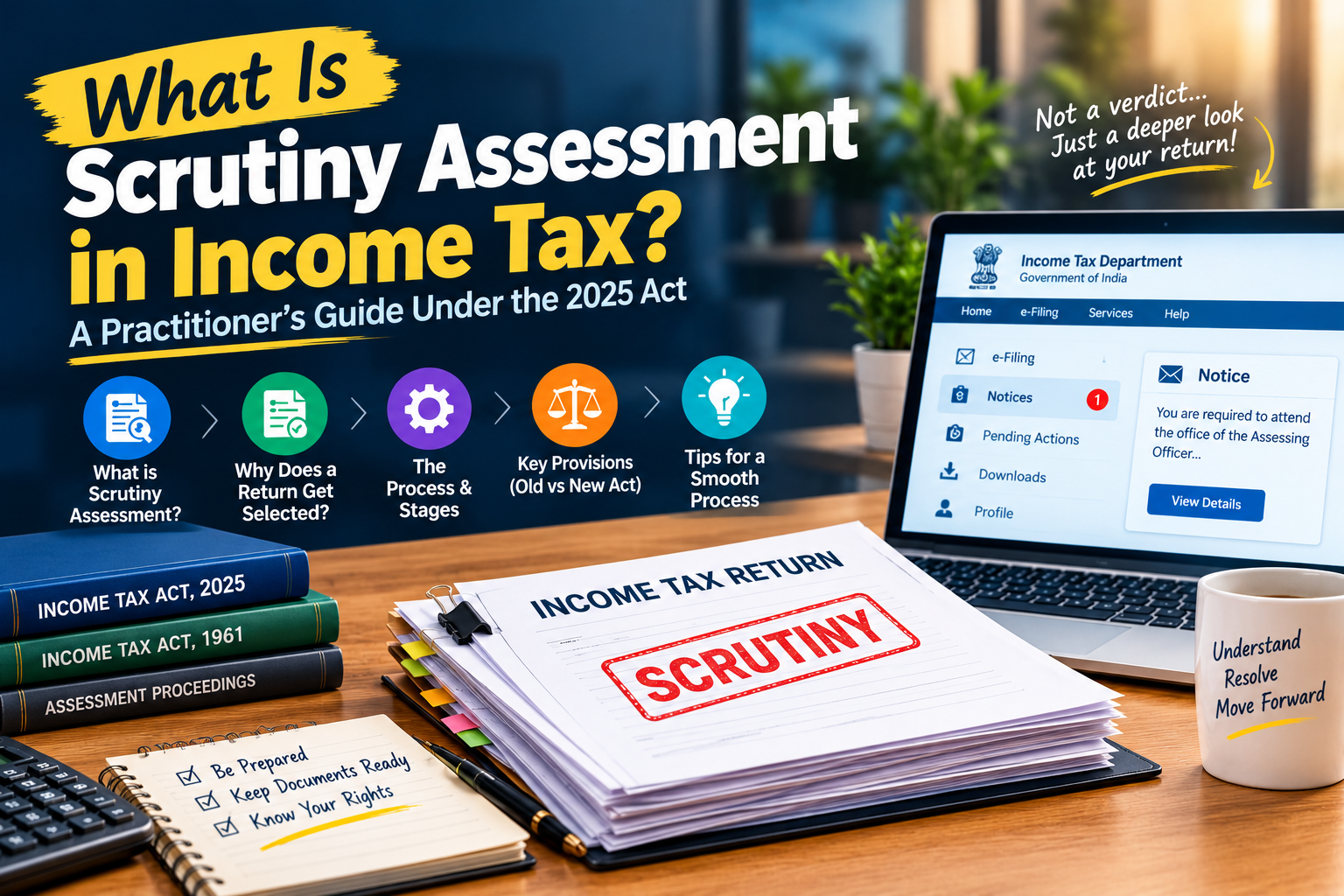
Somewhere on the income tax portal right now, a notice might be sitting in your inbox that opens with the line: “you are required to attend the office of the Assessing Officer…” If that’s what brought you here, take a breath first. A scrutiny notice isn’t a verdict — it’s the start of a conversation the department wants to have about your return, and how that conversation goes depends almost entirely on how well you understand what’s actually being asked.
I’ve sat across the table (virtually, these days) from enough clients over fifteen years to know that half the confusion around scrutiny has nothing to do with the facts of the case. It’s about not knowing what “scrutiny assessment” actually covers, why a particular return got picked out of the crores filed every year, and — now that the Income-tax Act, 2025 has renumbered almost every familiar section — which provision you’re even reading anymore.
This piece answers all three, mapped to both the old 1961 Act numbering most of us still think in, and the new 2025 Act sections that now govern the law.
What Scrutiny Assessment Actually Is
When you file your return, the department doesn’t simply accept your numbers on faith. Every return first goes through what’s called summary processing — an automated check for arithmetical mistakes, incorrect claims apparent from the return itself, and a few other listed inconsistencies. That’s governed by Section 270(1) of the Income-tax Act, 2025, which carries forward the old Section 143(1) of the 1961 Act almost without change. Most returns stop right there. Nothing dramatic happens; you get an intimation, and that’s the end of it.
Scrutiny assessment is a different, deeper level of examination. Here the Assessing Officer actually looks under the hood — calls for your books of account, bank statements, contracts, and third-party data such as your Annual Information Statement (AIS) and Form 26AS, and forms an independent view on whether the income you’ve returned is correct and complete. This power comes from Section 270(8) to (10) of the new Act, which is the direct successor to Section 143(2) and 143(3) of the 1961 Act. If, after examining everything, the officer is satisfied your return is accurate, the order simply confirms it. More often, some addition or disallowance gets proposed, and that’s where the real work — and often the real argument — begins.
One distinction worth getting right early: scrutiny is not the same thing as reassessment. Scrutiny happens on the return you’ve already filed, in the normal course, before the case becomes final. Reassessment — governed by Section 279 of the 2025 Act, which corresponds broadly to Sections 147 and 148 of the 1961 Act — reopens a case that the department believes escaped proper assessment the first time round, sometimes years later. It’s a big enough subject that it deserves its own article rather than a paragraph here, so I’ll leave it at that distinction for now.
Why Does a Return Get Selected for Scrutiny
CASS — the algorithm doing most of the picking
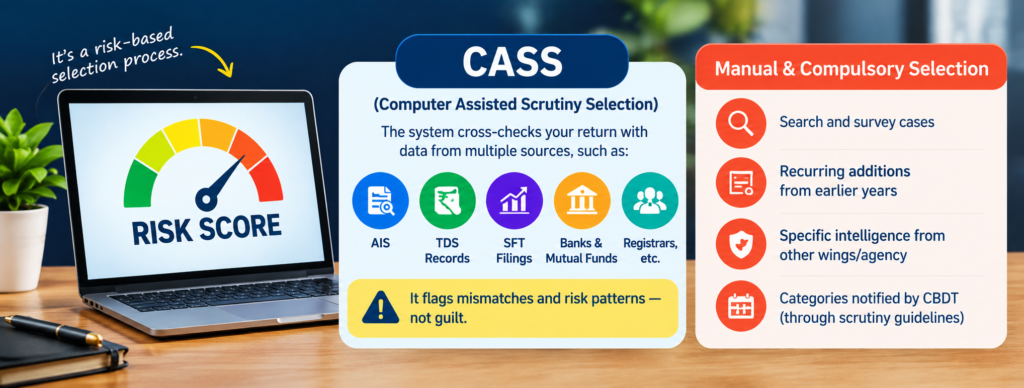
The bulk of scrutiny cases today are selected through CASS, the Computer Assisted Scrutiny Selection system. It’s essentially a risk-scoring engine that cross-checks your return against the data the department already holds about you — AIS, TDS records, SFT (Statement of Financial Transaction) filings from banks, mutual funds, registrars, and so on. A few patterns reliably trigger a flag: a big gap between reported income and high-value transactions on record, an unusually sharp fall in gross or net profit margin compared to earlier years, large refund claims, cash deposits that don’t square with the declared business, or capital gains and F&O income that doesn’t match what brokers have reported. None of this means you’ve done something wrong — CASS flags mismatches, not guilt. It just means someone now has to look and confirm the numbers add up.
Manual and compulsory selection
A smaller set of cases lands in scrutiny through manual or compulsory selection — search and survey cases, recurring additions confirmed in earlier years for the same assessee, specific intelligence from another wing of the department or another agency, and a handful of categories the CBDT notifies each year through its scrutiny selection guidelines. These tend to be more targeted and, frankly, more serious, because someone has already decided there’s a reason to look closely before your return was even processed.
A case I handled some time back is fairly typical of how CASS works in practice: a salaried professional who also traded in futures and options had reported only the salary income correctly, while the turnover computed from the broker’s contract notes — using the standard ICAI guidance note method — ran into several times that figure. The mismatch between AIS-reported broker data and the ITR was enough on its own to trigger a scrutiny flag, even though the trading itself was a loss overall. Once the turnover computation and the P&L reconciliation were placed on record, the addition CASS had flagged simply didn’t survive. The lesson holds for most clients: the flag tells you where to look, not what the outcome will be.
Limited Scrutiny vs Complete Scrutiny
This distinction matters more than most taxpayers realise. In limited scrutiny, the officer’s inquiry is confined to the specific issue — or issues — that triggered the CASS flag, say a mismatch in interest income or a large cash deposit, and can’t be widened to a full review of the return without specific administrative approval, which is meant to be the exception rather than the rule. Complete scrutiny, on the other hand, opens the entire return to examination. You can usually tell which one you’re in from the wording of the notice and the nature of the questions raised in the first round of inquiry; if the questions start drifting well beyond the flagged issue in a case marked limited scrutiny, that’s worth pushing back on, because it isn’t supposed to happen without proper conversion.
How the Process Sits Under the Income-tax Act, 2025
The 2025 Act didn’t rewrite assessment procedure from scratch — it renumbered it, tightened some drafting, and folded the faceless framework directly into the main provision instead of leaving it as a bolt-on scheme. A few things worth knowing if you’re used to the old numbering.
Section 270 of the new Act is the direct successor to Section 143 of the 1961 Act, and it now runs to fifteen sub-sections covering everything from summary processing to the final scrutiny order in one place. Within it, sub-section (8) is your old 143(2) notice, sub-section (9) carries forward the same three-month time limit for issuing that notice — measured from the end of the financial year in which the return was filed — and sub-section (10) is your old 143(3) assessment order.
Section 268 of the new Act replaces Section 142 of the 1961 Act — this is the inquiry-before-assessment provision, and it’s the one your document-heavy questionnaires actually come under, with sub-section 268(1) corresponding to the old 142(1). Where the officer needs you to explain a specific entry, produce a specific document, or justify a claim, it’s usually a 268(1) notice doing the asking, layered on top of the original 270(8) notice.
And Section 273 of the new Act — the successor to Section 144B — now expressly mandates that assessment under Section 270(10), best judgment assessment under Section 271, and income escaping assessment under Section 279 all be conducted in a faceless manner through the National Faceless Assessment Centre, unless the case falls into one of the narrow categories still handled outside NFAC, such as certain search-related and international tax matters. Practically, this means the overwhelming majority of scrutiny cases today involve no physical meeting with an officer at all — everything moves through the income tax portal’s e-Proceedings tab, and a personal hearing, if you need one, happens by video conference rather than in person.
This exact skill — reading a scrutiny notice, working out which sub-section you’re actually answering, and building a response strategy before the first questionnaire lands — is something we walk through case by case in the Income Tax Litigation Mastery course. It’s the kind of detail that decides whether a scrutiny case closes quietly or turns into a three-year fight.
📘 Want to Learn Income Tax Litigation Practically?
If you regularly handle scrutiny notices, assessments, replies, and tax litigation, our Income Tax Litigation Mastery Course is designed to help you understand the process practically under both the Income-tax Act, 1961 and the new Income-tax Act, 2025.The course covers practical scrutiny proceedings, notice-wise handling, drafting approaches, and real-world case handling so you can build a structured response strategy.
👉 Explore the course: https://courses.taxadvisory.in/
What Happens If You Simply Don’t Respond
I’d rather flag this plainly than bury it: ignoring a scrutiny notice is close to the worst option available. If you don’t respond, or your response is incomplete, the officer is entitled to complete what’s called a best judgment assessment under Section 271 of the new Act, old Section 144 — deciding your income based on whatever material is available, which is almost never in your favour. That, in turn, tends to open the door to penalty proceedings for under-reporting or misreporting of income. A response that’s late but complete is nearly always a better position than silence.
FAQs
What is the difference between scrutiny assessment and summary assessment?
Summary assessment (Section 270(1) of the 2025 Act, old Section 143(1)) is an automated check for arithmetical errors and a handful of listed mismatches — no officer actually reviews your case. Scrutiny assessment (Section 270(8)-(10), old Section 143(2)/143(3)) is a detailed examination where the Assessing Officer calls for evidence and forms an independent view on your income.
How do I know if my return has been picked for scrutiny?
You’ll receive a notice under Section 270(8) of the new Act, old Section 143(2), on your registered email and on the income tax portal, and it will also show up under the e-Proceedings tab once you log in. It’s worth checking that tab periodically even without a specific email, since notices can occasionally be missed in a crowded inbox.
Is every scrutiny case now conducted faceless?
Almost all of them. Section 273 of the 2025 Act, old Section 144B, makes faceless assessment the default for regular scrutiny, best judgment assessment, and income escaping assessment, with only a narrow set of exceptions — largely search-related and certain international tax cases — still handled outside the faceless scheme.
What is the time limit to respond to a scrutiny notice?
The notice itself will specify a compliance date, typically giving you somewhere between two and four weeks depending on the complexity of the query, though this can vary case to case. If you genuinely need more time, requesting an adjournment through the portal before the date lapses is far safer than letting it pass silently.
What happens once the scrutiny assessment order is passed?
You’ll get a written order under Section 270(10) along with a computation sheet and, if there’s a demand, a notice under Section 156. From there your options are to pay, seek rectification for any apparent error under Section 154, or file a first appeal before the Commissioner (Appeals) if you genuinely disagree with the order.
Scrutiny assessment sounds more alarming than it usually needs to be. Most cases turn on a handful of reconciliations — AIS data against your books, TDS credit against income disclosed, capital gains computation against contract notes — that a properly organised response can close out in one or two rounds. In the next piece, we’ll walk through exactly how the process moves stage by stage, from the first notice to the final order, so you know what to expect at each point along the way.