

Currently Empty: $0.00


Blog
How Scrutiny Assessment Is Completed: The Process and Stages Under the 2025 Act
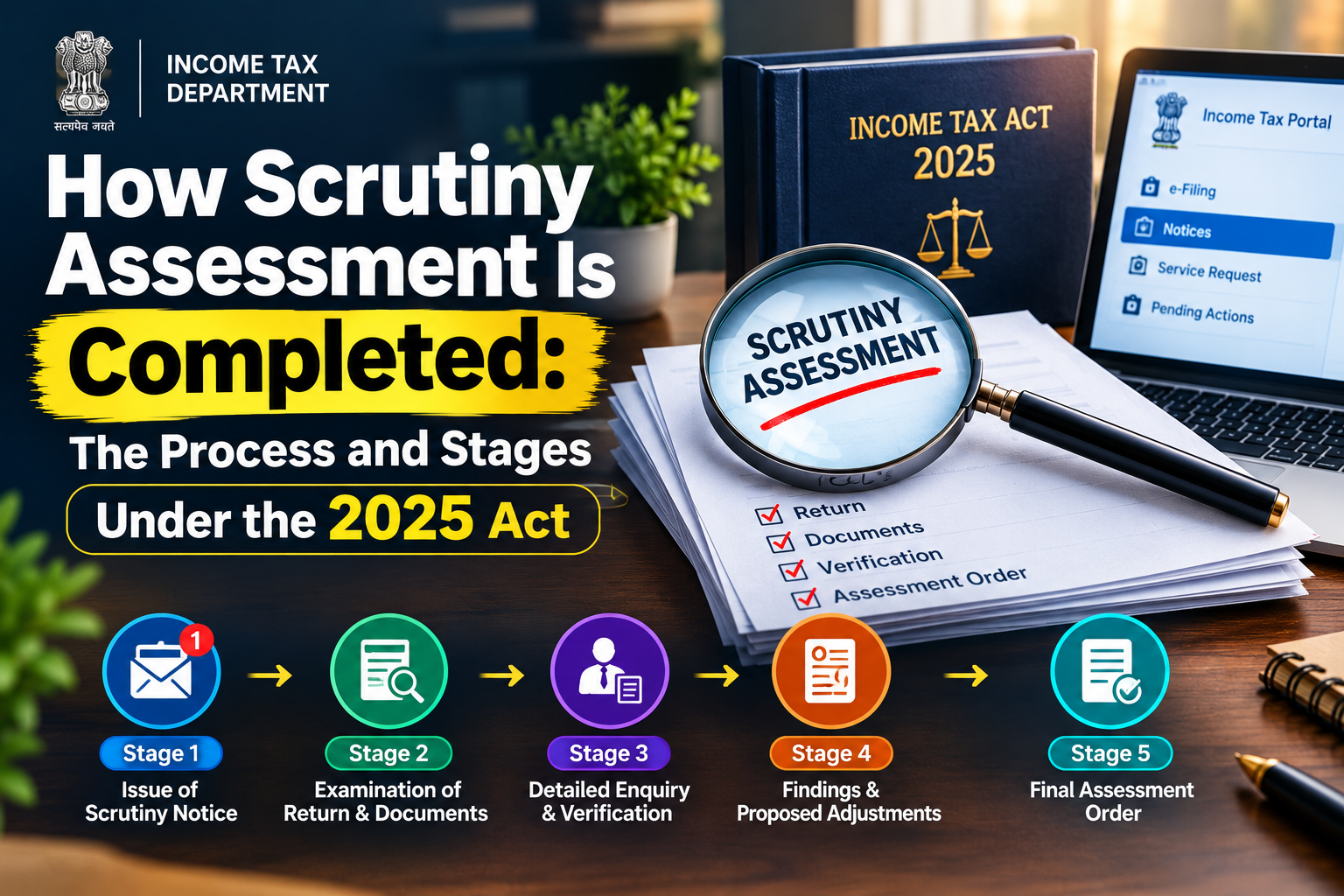
A client called me a while back, scrutiny notice in one hand, and asked the question every taxpayer eventually asks: “okay, so what actually happens now, step by step, until this is over?” It’s a fair question, and a surprisingly hard one to answer in one sentence, because a scrutiny case doesn’t move in a straight line — it moves in stages, each with its own notice, its own deadline, and its own way of going wrong if you’re not paying attention.
This piece is the companion to our earlier explainer on what scrutiny assessment is — here we’re walking through the actual mechanics, stage by stage, using the Income-tax Act, 2025 numbering, with the old 1961 Act sections noted alongside, since most of us are still translating between the two.
Stage One — Selection and the First Notice
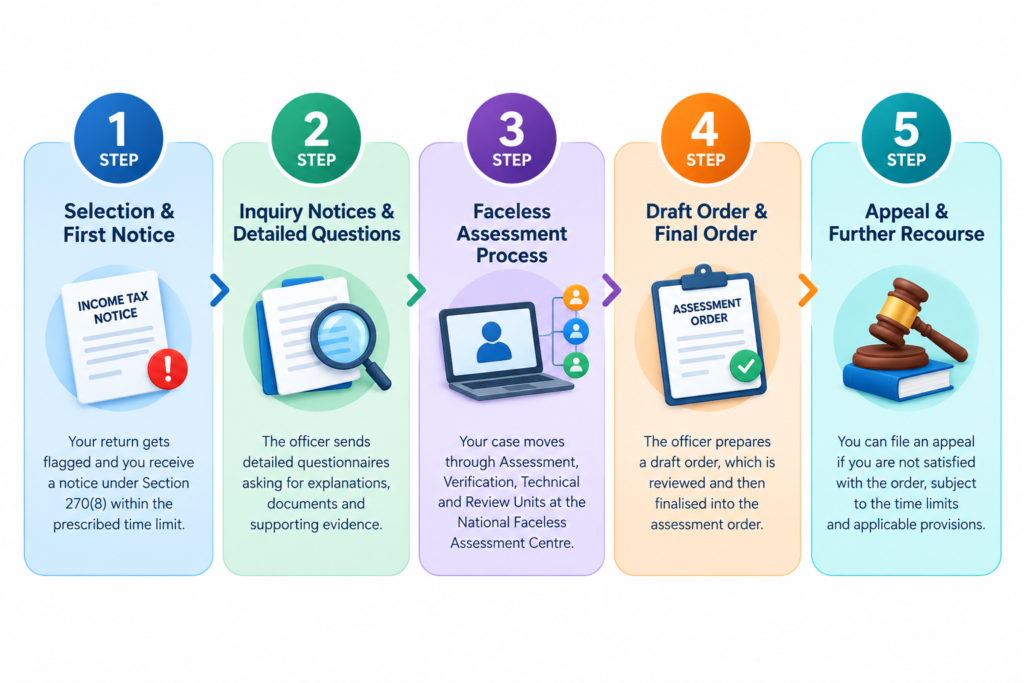
Every scrutiny case starts the same way: your return gets flagged, either by CASS or through manual or compulsory selection, and you receive a notice under Section 270(8) of the 2025 Act — the direct successor to old Section 143(2). This notice has to reach you within three months from the end of the financial year in which you filed your return; that time limit is fixed by Section 270(9) and hasn’t changed from the old law. Miss that window and the department loses the right to scrutinise that return at all, which is worth knowing if a notice ever looks like it’s arrived suspiciously late.
The first notice, in my experience, rarely tells you much on its face — it’s often a fairly generic communication asking you to log in and respond through the e-Proceedings tab. The real substance, what’s actually being questioned, usually comes in the next stage.
Stage Two — The Inquiry Notices and What They Actually Ask For
This is where the case gets real. Under Section 268(1) of the 2025 Act, old Section 142(1), the officer sends a detailed questionnaire, sometimes running to a dozen or more specific points, asking you to explain entries, reconcile figures, and produce supporting evidence. It’s not unusual for a single case to go through two or three rounds of these, especially in a faceless setup where each round tends to be narrower and more pointed than the last.
The documents actually asked for follow a fairly predictable pattern, and it’s worth having these ready before the first notice even lands if a return looks likely to be picked:
- Bank statements for all accounts held during the year, not just the ones you think are relevant
- Computation of income with supporting workings, and audited financials where applicable
- Sale and purchase invoices above the threshold the officer has flagged
- Loan confirmation letters from lenders, along with their PAN, where unsecured loans are in question
- Broker contract notes, ledger, and P&L statement for trading or capital gains income
- Property purchase or sale deeds where high-value transactions are involved
- TDS certificates and a reconciliation against Form 26AS/AIS for any mismatch flagged
The instinct with a long questionnaire is to answer defensively, point by point, in as few words as possible. I’d push back on that. A reply that explains the transaction in context — with a one- or two-line narrative before the supporting document — nearly always lands better with the officer reviewing it than a bare document dump, because faceless officers are working through dozens of files and a reply that’s easy to follow gets less pushback.
Stage Three — How the File Actually Moves Inside the Faceless System
Since Section 273 of the 2025 Act, old Section 144B, makes faceless assessment the default, it helps to understand how your file physically moves once you’ve responded. The National Faceless Assessment Centre allocates your case to an Assessment Unit, which frames the questions and eventually drafts the order. A separate Verification Unit examines and verifies the evidence you’ve submitted — cross-checking bank statements, confirming third-party information, and so on. Where a technical or legal question comes up, a Technical Unit weighs in. And before any order is finalised, a Review Unit examines the draft to check it’s legally sound and adequately reasoned. You, as the taxpayer, never see any of this happening — you only see notices coming in and your responses going out through the portal.
Where the department proposes an addition, or where you specifically request it, you’re entitled to a personal hearing conducted by video conference rather than in person. It’s worth asking for one in any case involving a genuine dispute on facts rather than a straightforward computational point — a VC hearing lets you actually walk the officer through a reconciliation in real time, which a written reply sometimes can’t do as effectively.
We spend an entire module in the Income Tax Litigation Mastery course on exactly this — how to structure a 268(1) reply so it reads well inside the faceless system, and when a VC hearing request actually helps your case versus when it’s better to let the written record speak for itself.
Stage Four — Show-Cause on the Proposed Addition
Before the final order, in most cases the Assessment Unit issues what’s effectively a show-cause communication — setting out the addition or disallowance it intends to make and giving you a further chance to respond before the order is passed. This is your last real opportunity to change the outcome before it becomes formal, and it deserves the same care as the original questionnaire, not a rushed one-line reply.
A note of caution on one narrow point: in a small category of cases — largely transfer pricing and certain cross-border matters — an eligible assessee can approach the Dispute Resolution Panel, which under the sources available to us appears to sit at Section 275 of the new Act, corresponding to old Section 144C. We’d flag that particular section number for a second check against the bare Act text before you rely on it for a client, since it’s a less common route for most domestic scrutiny cases and we weren’t able to cross-verify it as thoroughly as the other provisions in this piece.
Stage Five — The Final Order and the Demand
The case closes with a written order under Section 270(10) determining your total income and the tax payable, or refundable. If there’s a demand, you’ll also get a notice under Section 156 specifying the amount and the payment deadline. From here, your choices are to pay, to seek rectification under Section 154 if there’s a genuine error apparent from the record, or to file a first appeal before the Commissioner (Appeals) — each of which deserves, and will get, its own detailed piece on this blog.
The Time Limit Governing the Whole Process
The entire scrutiny process, from notice to final order, runs against a hard deadline. Section 286 of the 2025 Act, the successor to old Section 153, gives the Assessing Officer twelve months from the end of the financial year succeeding the relevant tax year to complete a regular assessment under Section 270(10) or a best judgment assessment under Section 271. Where a transfer pricing reference is involved, that period is extended by a further twelve months. In practice this means a return filed for a tax year ending 31 March 2026 could, in the ordinary course, see a scrutiny order any time up to 31 March 2028 — a long runway, and one reason cases can sometimes seem to go quiet for months before suddenly moving again as the deadline approaches.
What If You Miss a Compliance Date Somewhere in the Middle
It happens more often than anyone likes to admit — a client travelling, a document that takes longer to source than expected, an adjournment request that goes unanswered. If a compliance date passes without a response, the sensible move is still to respond as soon as you can, with a short explanation for the delay, rather than treating the case as lost. Officers do proceed to best judgment assessment under Section 271 in genuinely non-responsive cases, but a late, complete, well-reasoned reply — even a few days after the deadline — is very often still taken on record and considered before the order is finalised. Silence is the only response that reliably makes things worse.
📘 Learn the Complete Scrutiny Assessment Process Practically
Want to handle scrutiny proceedings more systematically? The Income Tax Litigation Mastery Course (1961 + 2025 Act) takes you through the complete process—from the first notice and 268(1) questionnaire to replies, faceless proceedings, show-cause notices, hearings, and the final assessment order.It is designed for practical learning, with notice-wise handling, drafting approaches and templates for real-world scrutiny matters.
👉 Explore the course: https://courses.taxadvisory.in/
FAQs
How long does a scrutiny assessment usually take from start to finish?
There’s no fixed number of rounds of notices a case will see, but the outer legal limit is twelve months from the end of the financial year succeeding the relevant tax year (Section 286 of the 2025 Act, old Section 153), extended by a further twelve months where transfer pricing is involved. Many straightforward cases close well within that, often in three to six months from the first notice.
Can I request a personal hearing in a faceless scrutiny case?
Yes. You can request a video-conference hearing, and in certain circumstances — such as where an addition is proposed — the faceless unit is required to offer one. It’s a genuinely useful option when a dispute turns on facts that are easier to explain out loud than in writing.
What documents does the department usually ask for during scrutiny?
It depends on the flag that triggered the case, but bank statements, computation of income, invoices above the flagged threshold, loan confirmations, broker or demat statements, and a TDS-to-AIS reconciliation cover most requests. Having these organised before the first notice lands saves considerable time later.
What happens if I miss a deadline during the scrutiny process?
Best judgment assessment under Section 271, old Section 144, becomes a real risk if you stay silent, but a late response with a genuine explanation is still almost always better than no response at all — officers routinely consider replies filed shortly after a lapsed date.
How do I track the status of my scrutiny case online?
Log in to the income tax e-filing portal and check the e-Proceedings tab under ‘Pending Actions’ — every notice issued and every response filed shows up there, along with the current status of the case.
None of these stages is complicated on its own — it’s the accumulation of deadlines, the faceless system’s particular way of asking questions, and the fact that most taxpayers are seeing all of this for the first time, that makes scrutiny feel harder than it needs to be. Once you know the shape of the process, it’s mostly a matter of organising your evidence and responding on time.