

Currently Empty: $0.00


Blog
Income Tax Penalty Proceedings: What Actually Happens After That Notice Lands
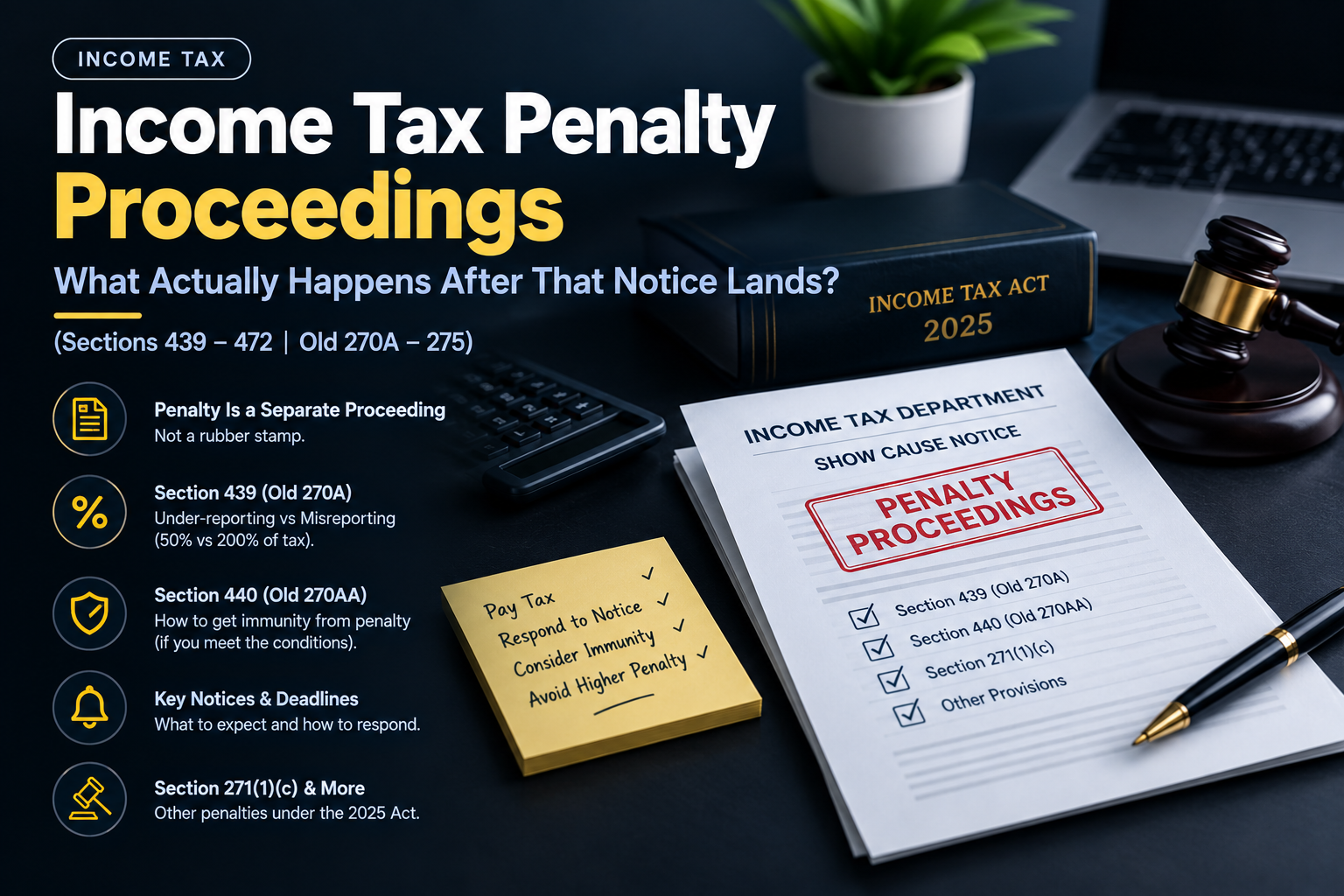
A client walked into my office last month holding an assessment order with one line that had made him go pale overnight: “penalty proceedings under section 270A are being initiated separately.” He had already paid the extra tax the department demanded on the addition. He thought that closed the chapter. It hadn’t — and that’s the part almost nobody explains to a taxpayer until the second notice actually shows up in their inbox.
Penalty under the income tax law isn’t a bolt-on to your tax bill that happens automatically. It’s a separate legal proceeding — its own show-cause notice, its own hearing, its own order, and, this is the part that actually saves people money, its own set of defences. If you’ve just read an assessment order with the words “penalty proceedings are being initiated” tucked into the last paragraph, this is the article to read before you do anything else.
I’ll use the numbering from the Income-tax Act, 2025 (the Act that governs assessment years 2026-27 onward), and put the familiar 1961 Act section right next to it in brackets, because most of us — practitioners included — still think in the old numbers out of fifteen years of habit. Where I genuinely couldn’t pin a number down against two independent sources, I’ve said so plainly instead of guessing.
Penalty Is a Separate Proceeding, Not a Rubber Stamp
The entire penalty framework sits in Chapter XXI of the new Act, running from Section 439 to Section 472 — the direct successor to the old Chapter XXI (the 270A/271-275 stretch of the 1961 Act) that every practitioner grew up with. Nothing in this chapter is automatic. An assessing officer who wants to levy a penalty has to record satisfaction, issue a separate notice, give the taxpayer a genuine opportunity to be heard, and pass a separate, reasoned order. Skip or shortcut any one of those steps and the order becomes vulnerable on appeal, often regardless of how strong the case on merits looks. In fifteen-plus years of litigation work, I’ve had more penalty orders set aside for a missed procedural step than for any argument about the actual addition.
Section 439 (Old Section 270A) — The One That Drives Most Penalty Orders
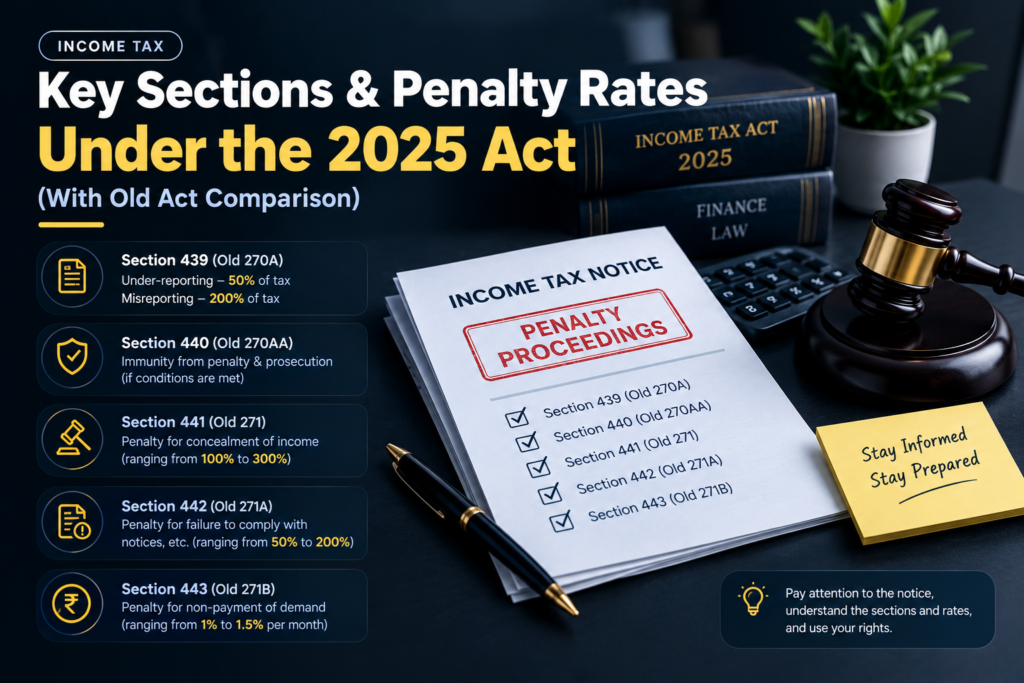
This single section accounts for the large majority of penalty notices I see land on a client’s desk. It splits penalty into two very different tiers, and the gap between them is enormous:
- Under-reporting of income — penalty of 50% of the tax payable on the under-reported amount.
- Misreporting of income — penalty of 200% of the tax payable on the misreported amount.
Put numbers to it: say a scrutiny assessment adds back ₹4,00,000 of income the officer feels wasn’t properly disclosed, taxed at 30%. That’s ₹1,20,000 of additional tax. If this gets classified as plain under-reporting — a genuine omission, a return that simply fell short of what the AO later computed — the penalty is roughly ₹60,000. If the same addition gets classified as misreporting — say, a fabricated purchase invoice, an investment kept entirely off the books, or a loss claimed with no real documentation behind it — the penalty jumps to ₹2,40,000 on the identical tax amount. Same addition, same tax effect, four times the penalty purely because of how it’s characterised.
That characterisation is decided by six specific situations the law treats as misreporting: misrepresentation or suppression of facts, false entries in the books, failure to record an investment, claiming expenditure without proper evidence, failure to record a receipt that affects total income, and failure to report an international or specified domestic transaction. We walk through all six of these limbs with actual order copies and ITAT reasoning inside the Income Tax Litigation Mastery course — it’s one of the areas where getting the classification argument right, rather than fighting the addition itself, is often what actually moves the penalty number.
Section 440 (Old Section 270AA) — The Immunity Route Most People Never Use
If an order has already proposed a penalty under Section 439, you aren’t stuck accepting it. Section 440 lets the assessee apply to the Assessing Officer for immunity from that penalty, and from the related prosecution provisions, provided two conditions are met: the tax and interest in the demand notice are paid within the time allowed, and no appeal is filed against the underlying assessment order. The application has to go in within one month from the end of the month in which the order was received, and the officer is required to decide it — giving the assessee a hearing before any rejection.
The trade-off is real and worth spelling out to a client in plain terms: you give up your right to appeal the addition, in exchange for capping your downside at the tax and interest alone instead of an extra 50% or 200% on top. I’ve recommended this route more than once for additions that were genuinely hard to defend on facts — it’s not a loophole, it’s a deliberate release valve the law builds in, and immunity isn’t available where the penalty itself was triggered under certain misreporting circumstances, so it needs checking case by case before you advise a client to pay up and forgo the appeal.
The Other Penalties That Show Up Every Day in Practice
Section 270A gets the headlines, but it’s far from the only penalty a practitioner deals with. A few that come up constantly:
- Section 441 (old 271A) — failing to keep or maintain books of account: a flat ₹25,000, regardless of how small or large the actual turnover is.
- Section 446 (old 271B) — missing the tax audit deadline: 0.5% of turnover or gross receipts, capped at ₹1,50,000.
- Section 448 (old 271C) — failing to deduct or deposit TDS: a penalty equal to the amount of tax not deducted or not paid. This one catches businesses off guard constantly — a genuine cash-flow crunch in depositing TDS that was already deducted can trigger a penalty equal to the full shortfall, stacked on top of interest.
- Sections 450, 451 and 453 (old 271D, 271DA and 271E) — the cash-transaction trio: taking a loan or deposit in cash above the prescribed limit, receiving cash above the limit in a single transaction, or repaying a loan in cash. Each carries a penalty equal to 100% of the amount involved — not a percentage of tax, the full amount itself. I’ve seen family settlements and property advances done in cash wipe people out here purely from not knowing these limits existed.
- Section 465 (old 272A) — not responding to a notice, not attending when summoned, or not furnishing information that was properly called for: ₹10,000 for every default.
How a Penalty Order Actually Gets Built — Section 471 (Old Section 274)
Before any penalty order is passed, the officer has to issue a show-cause notice that specifies the exact default and the exact limb of the law being invoked, and then give the taxpayer a genuine opportunity of being heard — not a formality ticked off for the file. A surprising number of the penalty orders I’ve challenged fall apart on exactly this ground: a notice issued and an order passed within days of each other, or a notice that cites the section but never actually specifies which of the six misreporting situations is being alleged. My standing advice to clients is simple — always ask, in writing, for the specific default and the specific limb being invoked, and always file a written response even when the honest answer is a flat denial. A silent file is a weak file.
Reasonable Cause Is a Real Defence — Section 470 (Old Section 273B)
Section 470 says that no penalty is to be imposed for a defined list of defaults — things like the books-of-account penalty, the audit penalty, and several of the compliance-notice penalties — if the person shows there was a reasonable cause for the failure. It doesn’t cover everything; the 200% misreporting penalty, for instance, isn’t the kind of default this provision was built to excuse. But where it does apply, it’s a genuine defence, not a technicality. I’ve had a tax audit filed late because the engaged chartered accountant was hospitalised with no one to hand over to, backed by hospital records and the correspondence trail, succeed as reasonable cause before the first appellate authority without much of a fight.
Don’t Ignore the Clock — Section 472 (Old Section 275): Bar of Limitation
Penalty orders have a shelf life. Under the 2025 Act, Section 472 ties the limitation period to the date the penalty notice is issued, with an outer cap running from the end of the relevant quarter, and shifts the levying power for several penalties from the Joint Commissioner down to the Assessing Officer. An order passed after the limitation window has closed is void on that ground alone, and date-stamps on the notice and the order are some of the first things worth checking in any penalty file.
I’ll be honest about one thing here: the precise day-to-day computation mechanics under this restructured section — exactly which event starts the clock in every fact pattern — are still being worked out in practice, since the 2025 Act’s penalty machinery is genuinely new and case law under it is only beginning to build up. Treat the bar-of-limitation argument as a live and useful defence, but verify the exact dates against the current gazette text for each specific case rather than relying on a general rule of thumb.
WANT TO GO DEEPER?
This overview covers the structure, but a real penalty file turns on classification arguments, immunity drafting, and limitation dates worked out precisely. The Income Tax Litigation Mastery (1961 + 2025 Act) course builds all of this out lecture by lecture, with case-law examples and drafting templates:
courses.taxadvisory.in — Income Tax Litigation Mastery
Frequently Asked Questions
What is the difference between under-reporting and misreporting of income under Section 270A (new Section 439)?
Under-reporting is the general case — any income assessed above what was declared — and draws a 50% penalty on the tax involved. Misreporting is a narrower, more serious category covering six specific situations such as false book entries, suppression of facts, or unreported international transactions, and draws a 200% penalty on the same tax amount. The classification, not just the amount of the addition, is what decides the bill.
Can I avoid penalty simply by paying the tax demand before the penalty order is passed?
Paying the tax and interest alone doesn’t automatically stop a penalty proceeding. What can stop it is a proper application for immunity under Section 440 (old Section 270AA), filed within the time limit, where you pay the tax and interest and also give up your right to appeal the underlying order. Paying the demand without filing that application leaves the penalty proceeding open.
Is there a time limit for the department to pass a penalty order?
Yes. Section 472 (old Section 275) sets a limitation period tied to the date the penalty notice is issued, with an outer time cap. An order passed outside that window can be challenged as void on that ground alone — always check the notice date and the order date against each other.
What happens if I genuinely didn’t maintain proper books of account?
Section 441 (old Section 271A) imposes a flat ₹25,000 penalty for failure to keep or maintain books, independent of the amount of income involved. It often arrives alongside a best-judgment style assessment, so the real exposure can be bigger than the penalty figure alone suggests.
Can a penalty be waived if there was a genuine reason for the default?
Section 470 (old Section 273B) allows several penalties — books of account, audit delays, and certain compliance defaults among them — to be dropped entirely if reasonable cause is shown and properly documented. It doesn’t extend to every penalty, and it’s rarely successful against the 200% misreporting penalty, so it’s worth checking which specific default you’re defending before building a case around it.
That client I mentioned at the start eventually filed for immunity under Section 440, paid what was owed, and let the appeal window close. It wasn’t the outcome he walked in hoping for, but it was the right call once we’d actually worked through the numbers — and that’s really the point of understanding this chapter before the second notice arrives, not after.