

Currently Empty: $0.00


Blog
Income Tax Demand Notice and Recovery Proceedings: What Really Happens If You Don’t Pay
A client once told me, half-joking, that he treats income tax demand notices the way he treats gym membership renewal emails — he scrolls past and assumes someone will remind him again later. Nobody reminded him. Three months after a reassessment order, his current account had a hold on it he hadn’t seen coming, and only then did he call me. We fixed it, but it cost him more in stress and in the fee he could have avoided than if he’d picked up the phone the week the notice landed.
Demand notices don’t disappear if you ignore them, and the machinery behind them moves faster than most people expect. Here’s how it actually works, mapped to the Income-tax Act, 2025, with the old 1961 Act numbering alongside, since most of us are still mentally translating between the two.
What a Notice of Demand Actually Is — Section 289 (Old Section 156)
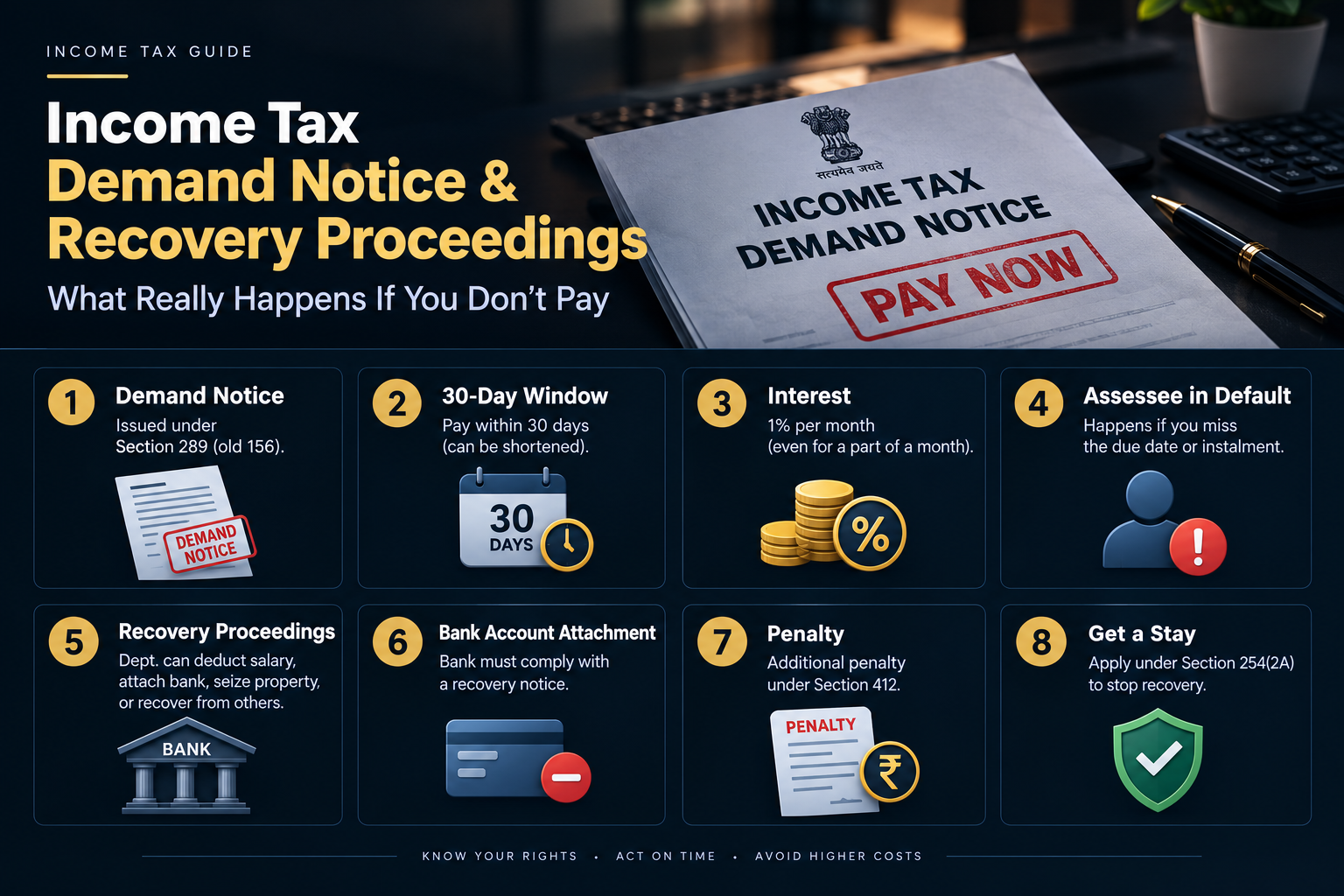
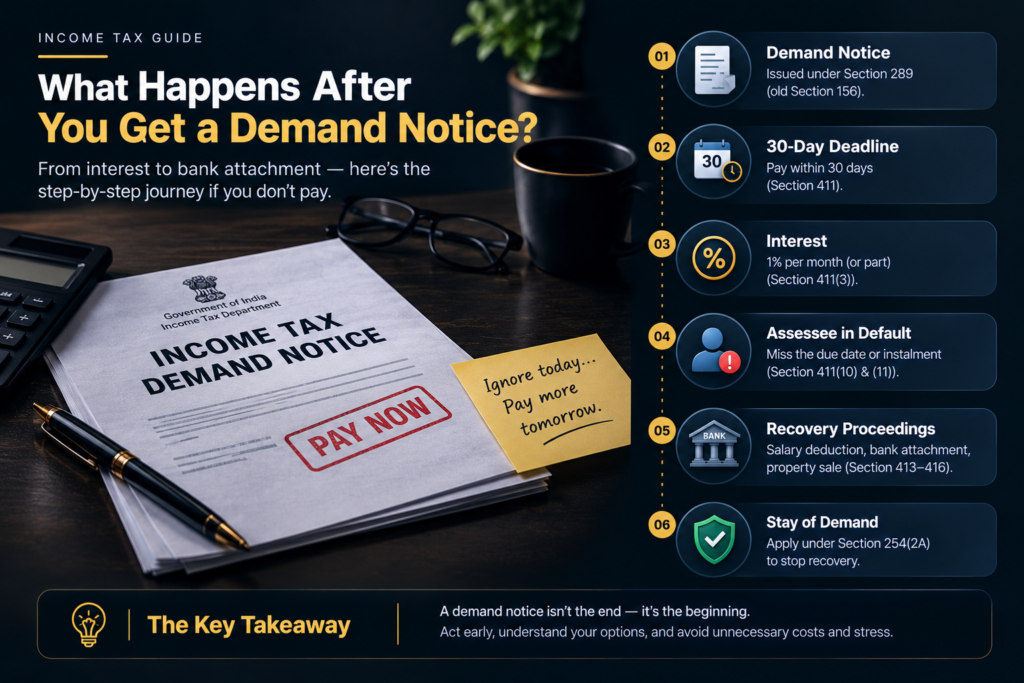
Any time an order creates a tax liability — a scrutiny assessment, a rectification under Section 287 (old 154), a penalty order, almost anything that ends with “you owe this much” — the department follows it up with a formal notice of demand under Section 289. This is the document that starts the clock. It’s not a reminder; it’s the trigger for everything described below. If the underlying demand later gets reduced, say because of an Insolvency and Bankruptcy Code order, Section 290 provides for a modified notice of demand reflecting the lower figure.
The 30-Day Clock — Section 411 (Old Section 220)
Once that notice is served, you have 30 days to pay, under Section 411(1). What a lot of people don’t realise is that this 30-day window isn’t guaranteed. The Assessing Officer can shorten it, with the Joint Commissioner’s prior approval, if giving you the full 30 days would be detrimental to revenue — typically where there’s a real flight risk on recovery. So don’t assume you automatically get a month to arrange funds; read the notice carefully for the actual due date stated on it.
Miss that deadline and interest starts running under Section 411(3) at 1% for every month or part of a month of default, calculated from the day after the due date until the date you actually pay. “Part of a month” is deliberately unforgiving — pay on the 31st day after a 30-day month and you’re charged interest for a full month, not a day.
If you genuinely can’t pay in one go, Section 411(5) lets you apply, before the due date, for an extension or instalments, subject to whatever conditions the Assessing Officer sets. The operative phrase is before the due date — applying for instalments after you’ve already defaulted is a much weaker position to argue from.
When You Become an “Assessee in Default”
Fail to pay by the due date, or by an extended date you were granted, and Section 411(10) deems you an assessee in default on that amount. Miss one instalment under a payment plan and Section 411(11) treats you as in default on the entire outstanding balance, with the remaining instalments all falling due immediately. This label matters because it’s what unlocks the recovery machinery described below — it isn’t just a bookkeeping term.
Separately, Section 412 (old Section 221) allows a penalty for default in payment of tax, over and above the interest already running under Section 411. In my experience, officers don’t reach for this penalty in every case, but it’s there, and it’s one more reason not to let a demand sit unpaid on the theory that “interest is the only cost.”
How the Department Actually Recovers the Money
This is the part that surprises people most, because it doesn’t involve going to a civil court first. Once you’re an assessee in default, a certificate specifying the arrears is drawn up under Section 413 (old Section 222) and sent to the jurisdictional Tax Recovery Officer under Section 414, who then has a fairly wide toolkit under Section 416 (old Section 226):
- Deduction directly from salary, where the assessee is an employee.
- A written notice — functionally a garnishee notice — to any person who owes money to the assessee, or holds money on the assessee’s behalf, including banks, directing them to pay that amount over to the department to cover the arrears. Anyone who gets such a notice is legally bound to comply, and a bank or other party that ignores it can itself be treated as an assessee in default for that amount.
- Attachment and sale of the assessee’s movable property.
- Application to a court that’s already holding money belonging to the assessee.
Beyond this, the broader recovery framework still allows attachment and sale of immovable property, appointment of a receiver over the defaulter’s assets, and — in the small minority of genuinely willful, high-value default cases — arrest and detention, following the same structure the old Second Schedule machinery used under the 1961 Act.
Can the Department Really Freeze Your Bank Account Without Going to Court First?
Yes, and this is exactly what happened to my client. The garnishee-style notice under Section 416 doesn’t need a separate court order — the bank simply gets a written notice naming the amount to be paid over, and is obligated to comply. The one piece of reassurance here is that it’s not instant and silent: you’ve already received the Section 289 demand notice, the 30-day window has already run out, and usually there’s been at least some further correspondence before the department goes after a bank account specifically. The protection isn’t “it can’t happen,” it’s “you had notice and time to act before it did.”
Getting a Stay of Demand While Your Appeal Is Pending
If you’ve filed an appeal under Sections 356 or 357 (old Sections 246A and 249) and the demand is genuinely in dispute, Section 411(12) allows the Assessing Officer, at their discretion, to treat you as not in default on the disputed amount until the appeal is decided. In practice, this discretion is exercised against the long-standing CBDT administrative guideline that a stay is typically granted on deposit of 20% of the disputed demand, pending disposal by the first appellate authority. That 20% figure is administrative practice rather than a hard statutory floor, and courts have on occasion directed authorities to accept a lower deposit where the facts justified it — so if 20% is genuinely unaffordable, it’s worth making that case in writing rather than assuming it’s non-negotiable.
The practical move, every time, is to file the stay application the moment you file the appeal — not after a recovery notice has already landed. A stay request filed proactively is a request for breathing room. The same request filed after a garnishee notice to your bank is a request to undo something that’s already in motion, and that’s a harder conversation to have with an officer.
Tax Clearance Certificates and Other Fine Print
Section 420 (old Section 230) deals with tax clearance certificates — relevant mainly to specific categories of taxpayers in situations involving foreign travel or certain pending proceedings, rather than something the average salaried or business taxpayer needs to think about day to day. I’m flagging it here mainly so the picture of the collection-and-recovery chapter is complete, not because it’s where most readers will spend their time.
This entire sequence — demand, default, the recovery officer’s powers, and how to get ahead of it with a stay application — is exactly the kind of practical mechanics we work through with real notices and real numbers in the Income Tax Litigation Mastery course, because reading about Section 416 in the abstract is very different from watching a garnishee notice land in a client’s inbox.
A Quick Real Example
A different client received a reassessment demand of roughly Rs 5.4 lakh and let the 30-day window pass without responding, assuming the pending appeal would automatically protect him. It doesn’t, unless you specifically apply for it. By the time he reached out, a Section 416 notice had already gone to his bank. We filed the stay application immediately, deposited 20% of the disputed amount, and the recovery notice was withdrawn within the week — but that 20% had to come from somewhere on short notice, which is exactly the scramble a timely application would have avoided.
| Want to actually know how to draft a stay application, respond to a demand, and handle recovery notices before they escalate — not just read about them? The Income Tax Litigation Mastery (1961 + 2025 Act) course covers this with real drafting templates and case walkthroughs. See the course details → |
Frequently Asked Questions
- What happens if I don’t pay an income tax demand within 30 days?
You become an “assessee in default” under Section 411 (old Section 220), interest at 1% per month starts running from the due date, and the department can begin recovery proceedings, including attaching bank accounts or salary, through the Tax Recovery Officer.
- Can the Income Tax Department attach my bank account without a court order?
Yes. Under Section 416 (old Section 226), the department can send a written notice directly to your bank or to anyone who owes you money, and they’re legally required to pay over the amount to cover your tax arrears — no separate civil court order is needed for this step.
- How do I apply for a stay of demand while my appeal is pending?
File a written stay application with your Assessing Officer alongside your appeal under Sections 356/357 (old 246A/249), referencing Section 411(12). The standard administrative practice is a stay against deposit of 20% of the disputed demand, though a lower figure can be argued on the facts.
- Is interest charged on an unpaid income tax demand, and at what rate?
Yes — 1% per month or part of a month under Section 411(3) (old Section 220(2)), running from the day after the due date stated on the demand notice until the date of actual payment.
- What does a Tax Recovery Officer do, and when do they get involved?
Once you’re deemed an assessee in default, a certificate of arrears is drawn up under Section 413 (old Section 222) and forwarded to the Tax Recovery Officer under Section 414, who then has the power to recover the amount through salary deduction, garnishee notices, attachment of property, and similar measures under Section 416.