
Currently Empty: $0.00


Blog
What Is Scrutiny Assessment Under Income Tax? A CA Explains What It Really Means
Every year, right around the time refund credits start showing up in people’s bank accounts, my phone starts ringing in a very particular way. The caller is usually calm for the first ten seconds, and then the sentence comes out in a rush: they’ve received an email from the Income Tax Department, the word “scrutiny” is somewhere in the subject line, and they want to know if they’re in trouble.
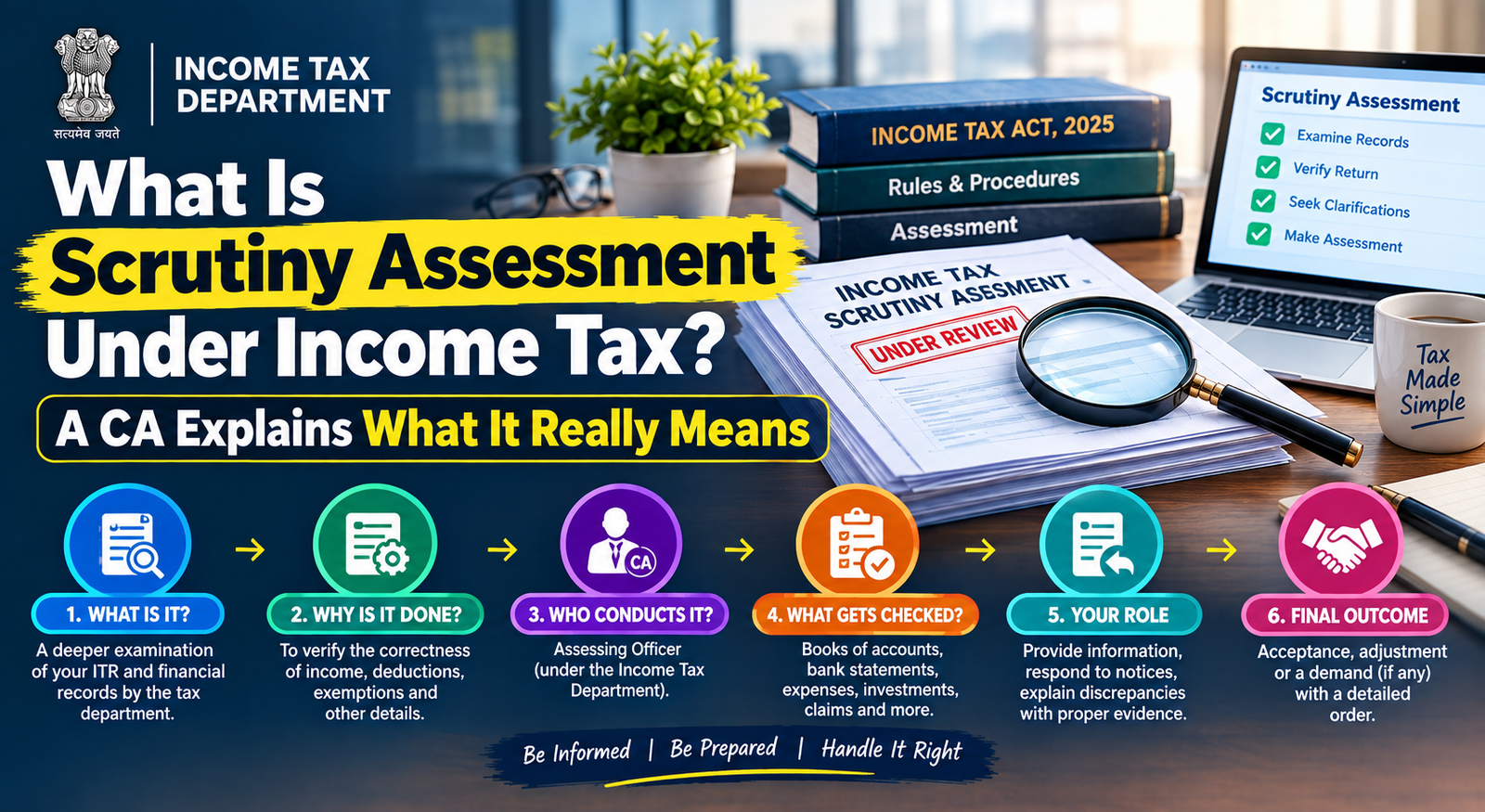
Here’s what I tell almost all of them: scrutiny assessment is not an accusation. It’s a mechanism built into the law that lets the Assessing Officer look more closely at a return before it becomes final. Understanding what triggers it, what it actually involves, and where it sits in the wider assessment framework takes most of the fear out of the process — even if it doesn’t take away the paperwork.
What “Scrutiny Assessment” Actually Means
When you file your return, the first thing that happens to it is automated processing — a computer checks the arithmetic, matches your TDS claims against Form 26AS, and sends you an intimation. Under the 1961 Act this happened under Section 143(1); under the Income-tax Act, 2025, the same processing now sits in sub-sections (1) to (7) of Section 270.
Scrutiny is the next, far more serious layer. It’s a detailed re-examination of specific claims, deductions, or the entire return, carried out by an Assessing Officer who has flagged something worth a closer look. Under the old law this was Section 143(3). Under the Income-tax Act, 2025 — which applies from 1 April 2026, covering income earned in FY 2026-27 onward — the same power now sits in sub-sections (8) to (15) of the same Section 270. Both provisions do the same job; the 2025 Act has simply folded processing and scrutiny into one longer section instead of splitting them across 143(1) and 143(3).
If your case relates to an earlier assessment year, don’t worry about the new numbering at all — it will run entirely under the 1961 Act until the transition is complete. I’m giving both numbers throughout this piece because a lot of my own clients are going to be dealing with both systems side by side for the next couple of years, and it helps to know which one you’re actually reading.
Why Would the Department Pick Your Return At All?
This is the question that actually worries people, and it’s a fair one. Barring a handful of mandatory categories, most scrutiny selection happens through CASS — the Computer Assisted Scrutiny Selection system. It’s a risk-based filter that runs your return against your AIS, your TIS, your TDS/TCS statements, and a set of parameters the CBDT revises every year. A few of the more common triggers I run into in practice:
- A large gap between the TDS deducted on your income, as per Form 26AS, and the income you’ve actually declared.
- Cash deposits that don’t sit comfortably against your declared turnover or income — this is the single most common one I handle for small traders and shopkeepers.
- A refund claim that looks disproportionately large next to your income profile.
- Specific information received from another agency — a bank, a sub-registrar, GST authorities — that doesn’t match what you’ve reported.
- Recurring additions on the same point in an earlier year that you haven’t accepted or appealed.
Separately, the CBDT publishes a fresh set of guidelines every financial year for compulsory scrutiny — cases involving surveys, search action, or specific complaints, which get picked up regardless of what CASS says. If your case falls into one of those categories, the nature of the notice usually makes that fairly obvious.
Limited Scrutiny, Complete Scrutiny, and the Difference That Actually Matters
Not every scrutiny case is the same size. A limited scrutiny notice restricts the Assessing Officer to one or two specific issues — say, a mismatch in your capital gains schedule, or a single large cash deposit. You genuinely don’t need to lose sleep over your entire return being reopened in these cases; the officer needs specific approval to go beyond what was flagged.
Complete scrutiny is exactly what it sounds like — your entire return, every schedule, every claim, is open for examination. This happens either because your case fell into one of the CBDT’s compulsory categories to begin with, or because a limited scrutiny case turned up something serious enough that the officer sought approval to widen it.
I had a client a couple of years back — a small manufacturing unit — whose case started as limited scrutiny over a single cash deposit of about eleven lakh rupees. The explanation for that one deposit was straightforward, an advance against a large order that later fell through, but while going through the bank statement the officer noticed a pattern of similar unexplained deposits, took approval, and converted the case to complete scrutiny. That’s a fairly typical way these things escalate, and it’s exactly why I tell clients never to treat even a “small” scrutiny notice casually.
How This Is Different from an Inquiry Notice or a Reassessment Notice
People often use “scrutiny notice” loosely to describe any letter from the department, and that causes real confusion. A notice asking you to furnish documents or explain specific entries — issued under old Section 142(1), now Section 268 of the 2025 Act — is a general inquiry power, and it can be used even before or alongside a scrutiny notice. A scrutiny notice proper, old Section 143(2) and now Section 270(8)-(9), is the formal trigger telling you your return has actually been picked up for detailed examination.
Reassessment is a different animal altogether. Scrutiny happens before your original assessment is finalised. Reassessment — old Sections 147/148, now Section 279 of the 2025 Act — happens after the assessment is already complete, when the department later gets reason to believe income has escaped assessment. If you’ve already been through scrutiny and received your order, what you might face next isn’t another round of scrutiny on the same year; it’s reassessment, and that’s a separate proceeding with its own rules.
This distinction — reading a notice correctly on day one and knowing exactly which provision you’re dealing with — is one of the first things I walk through with students in the Income Tax Litigation Mastery course, because getting it wrong at the start almost always costs more time later than it would have taken to get it right the first time.
What Happens If You Just Don’t Respond
I’ve seen this go badly more times than I’d like. If you ignore a scrutiny notice, fail to produce the documents asked for, or simply stop responding partway through, the Assessing Officer doesn’t have to wait for you indefinitely. Under old Section 144 — Section 271 of the 2025 Act — the officer can pass a best judgment assessment, estimating your income based on whatever material is available, and this almost always turns out worse than if you’d engaged with the process properly. Add the real possibility of penalty proceedings once such an order is passed, and non-response ends up being the single most expensive mistake I see in this entire area.
A Few Myths Worth Clearing Up
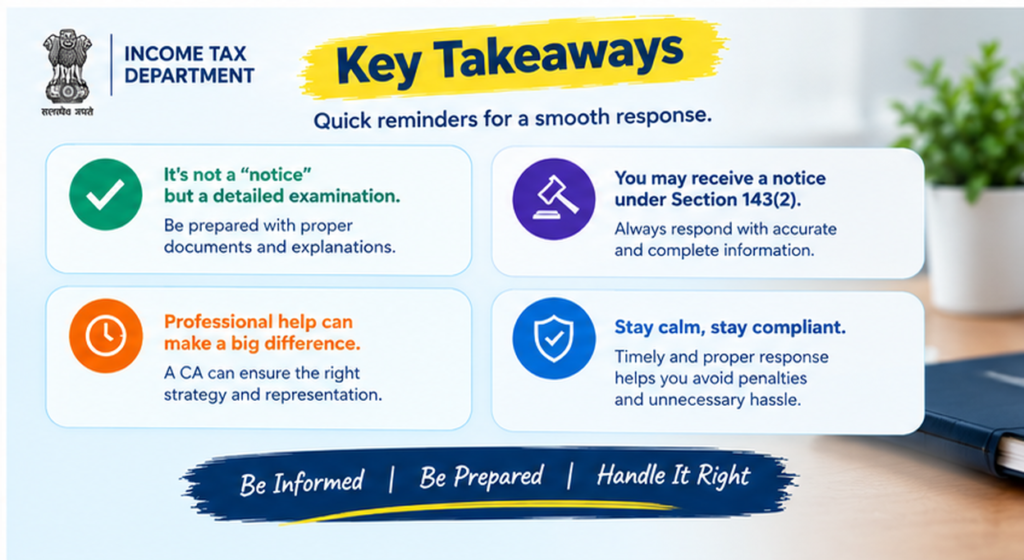
Scrutiny doesn’t mean you’re suspected of a crime — it’s a civil re-examination of your tax return, not a criminal proceeding. It isn’t reserved for businesses either; salaried individuals with large capital gains, foreign remittances, or unusual deductions get picked up just as often. And no, an unanswered notice doesn’t quietly disappear with time — silence gets read as non-compliance, and the assessment proceeds on that basis.
Want to Learn Income Tax Litigation Practically?
If you regularly handle scrutiny notices, assessments, replies, and tax litigation, our Income Tax Litigation Mastery Course is designed to help you understand the process practically under both the Income-tax Act, 1961 and the new Income-tax Act, 2025.The course covers practical scrutiny proceedings, notice-wise handling, drafting approaches, and real-world case handling so you can build a structured response strategy.
Explore & Enrol: https://courses.taxadvisory.in/
Frequently Asked Questions
Does every income tax return get scrutinised?
No. The overwhelming majority of returns go through automated processing under Section 270(1)-(7) of the 2025 Act (old Section 143(1)) and nothing further happens. Scrutiny applies to a small minority of cases, either flagged by CASS or falling under a compulsory category notified by the CBDT.
What is the time limit for issuing a scrutiny notice?
The notice must be served within three months from the end of the financial year in which you filed your return. This hasn’t changed in substance between old Section 143(2) and the new Section 270(10) of the 2025 Act.
Can I still be scrutinised after my refund has already come in?
Yes. Processing your return and issuing a refund under Section 270(1)-(7) is a completely separate step from scrutiny. Getting your refund is not a clean chit — a scrutiny notice can still follow within the statutory time limit.
Is scrutiny assessment done in person, or is it faceless now?
For the large majority of cases, it’s faceless, run through the National Faceless Assessment Centre under old Section 144B, now Section 273 of the 2025 Act. A video-conference hearing can be requested in specified circumstances.
What’s the real difference between scrutiny and reassessment?
Timing, mainly. Scrutiny examines a return before the original assessment is finalised. Reassessment reopens a case after the assessment is already complete, when the department has reason to believe income has escaped assessment — that’s old Sections 147/148, now Section 279 of the 2025 Act.