

Currently Empty: $0.00


Blog
How to Reply to an Income Tax Scrutiny Notice: A CA’s Step-by-Step Guide Under the 2025 Act
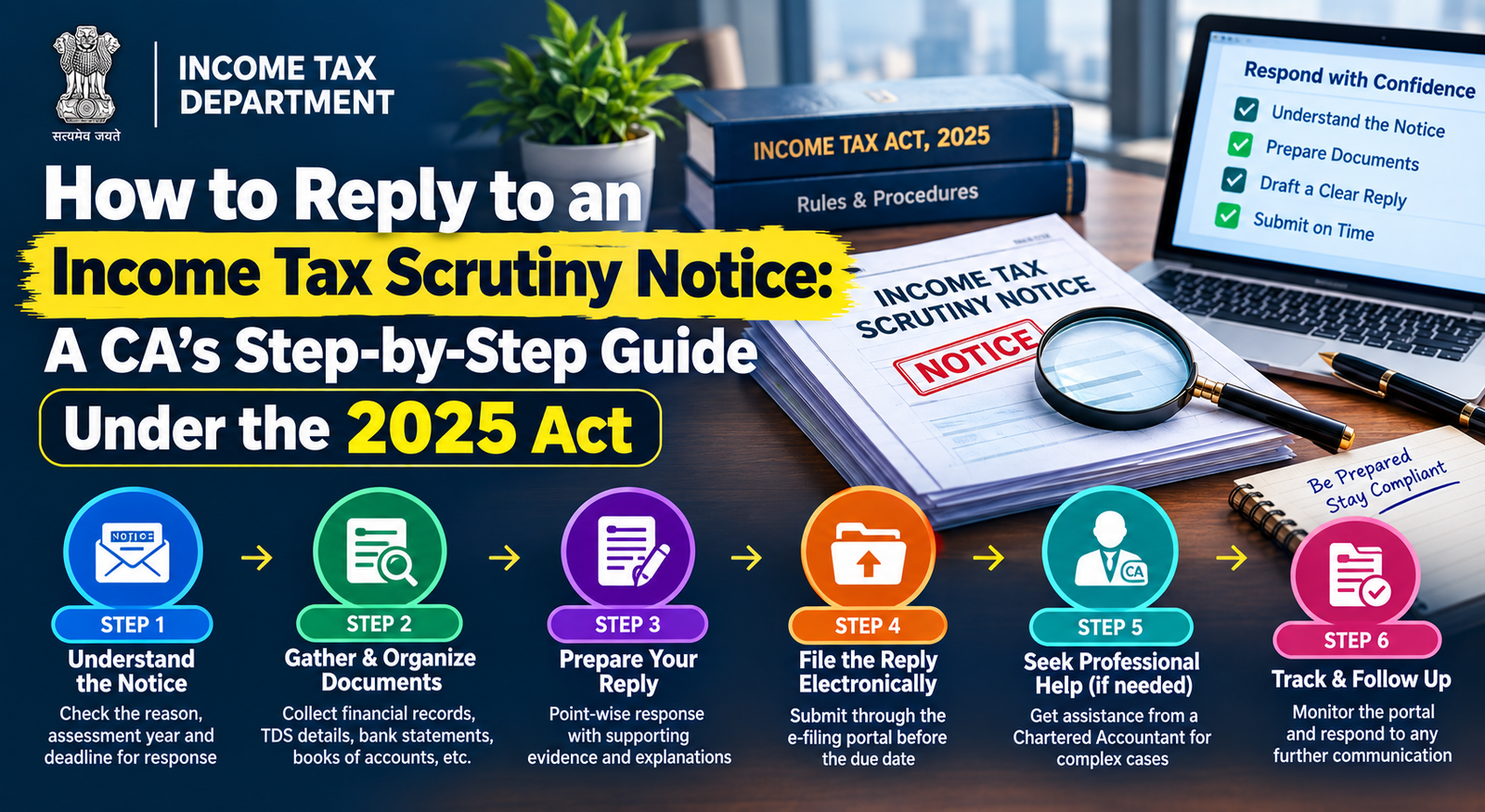
A scrutiny notice lands in the inbox and most people’s first reaction is panic, closely followed by a frantic call to whichever CA number is saved in their phone. I get that call a few times a month, and it almost always opens the same way: “Sir, mujhe income tax ka notice aaya hai, kya karna hai ab?” Fair enough – the notice does look intimidating, full of section numbers and a portal link that assumes you already know your way around the e-filing website. But once you’ve handled a few dozen of these, you realise the process is fairly mechanical, and the outcome depends far more on how carefully you respond than on how scared you were on day one.
This piece walks through exactly how to reply to a scrutiny notice – what it means, where to log in, what to write, and the mistakes that turn a routine scrutiny into a prolonged, expensive dispute. I’ll use the numbering under the new Income-tax Act, 2025, since that’s now the operative law, but I’ll keep pointing back to the old 1961 Act sections too, because that’s still how most of us think and talk about these notices.
What Exactly Is a Scrutiny Notice, and Which Section Governs It Now
Under the 1961 Act, a scrutiny case was opened with a notice under Section 143(2). Under the Income-tax Act, 2025, that same power sits in Section 270, with the actual notice for scrutiny issued under Section 270(8) – the assessment machinery itself is largely carried forward from the old Section 143, just renumbered. If your return has been picked up for detailed examination (as opposed to the automated processing every return goes through), this is the notice that tells you so.
Separately, you may also receive a notice under Section 268(1) of the 2025 Act – this is the old Section 142(1) territory, where the Assessing Officer asks you to produce specific accounts, documents or information. In practice the two arrive close together, or the 268(1)/142(1) notice follows the 270(8)/143(2) notice once the officer has looked at your file and decided what to ask for. People often use “scrutiny notice” loosely for both, so I’ll address the reply process for both, since the drafting discipline is the same.
One thing worth saying plainly here: while the assessment framework itself has clearly moved from Section 143/142 to Sections 270/268 in the enacted 2025 Act – confirmed across multiple independent commentaries, not just my own reading – a handful of the more granular penalty-for-non-compliance provisions under the new Act haven’t been as consistently reported yet. So later in this piece, where I talk about the risk of not replying, I’m going to flag that honestly rather than quote you a section number I can’t stand behind.
Step 1: Confirm It’s Genuine and Read It Properly Before You Do Anything Else
Before you touch the portal, read the notice twice. Note three things: the assessment year it relates to, the compliance date, and whether it’s a straightforward 270(8) notice (asking you to be present or file details online) or a detailed 268(1) requisition with a list of specific queries attached as an annexure. Almost all scrutiny today runs through the Faceless Assessment framework, so you won’t be walking into an income tax office and meeting an officer face to face – everything happens through the e-filing portal’s “e-Proceedings” tab.
Also check the DIN – the Document Identification Number printed on every valid communication from the department. A notice without a valid DIN, or one that doesn’t show up when you verify it on the portal, is something you flag rather than act on. This isn’t paranoia; fraudulent notices genuinely do circulate, and verifying the DIN takes thirty seconds.
Step 2: Log In and Locate the Notice on the e-Filing Portal
Go to the income tax e-filing portal, log in with your PAN, and open “Pending Actions” followed by “e-Proceedings.” You’ll see the notice listed with a “Submit Response” or “Reply” option. Click through and you’ll typically find one of two formats: a set of specific questions the officer wants answered, or a general “furnish details in support of the return filed” ask that requires you to build your own narrative response.
Don’t reply from the portal in a hurry just because the option is sitting right there. I always tell clients: draft your reply offline first, in a Word document, get it reviewed, attach supporting documents in the right order, and only then upload it through the portal. A rushed reply typed directly into a text box, with half the numbers off by a decimal, is how simple scrutiny cases turn into extended, painful ones.
Step 3: Build the Reply Around the Actual Query, Not Your Entire Financial Life
This is where most self-filed replies go wrong. People tend to either say too little (“As per attached documents, kindly verify”) or dump every bank statement, investment proof and rent receipt they own regardless of whether it was asked for. Neither works. A good reply does three things: it restates the query in your own words so there’s no ambiguity about what you understood was asked, it answers that specific query with reference to the return already filed, and it attaches only the supporting document that proves the point – nothing more.
Say the notice questions a large cash deposit of Rs 8 lakh in your savings account during the year. The reply shouldn’t just be “amount received from father.” It should say something like: “The cash deposit of Rs 8,00,000 on 2026 represents agricultural sale proceeds received from my father, Shri [name], who holds [X] acres of agricultural land at [location]. Supporting documents enclosed: (a) land ownership records, (b) mandi sale receipts for the relevant crop season, (c) a confirmation letter from the father with his PAN and address.” That level of specificity closes the query. A vague answer invites a follow-up notice, and a follow-up notice from an officer who’s already unconvinced is a harder conversation than the first one.
A Short Real Example
I had a case last year where a salaried client’s Form 26AS showed a mismatch of about Rs 40,000 between the TDS his employer reported and what he’d claimed. Turned out the employer had revised the TDS return mid-year and the client’s original computation used an older 26AS pull. The reply we filed simply attached the revised Form 26AS, the salary certificate, and a one-paragraph explanation of the timeline. No drama, no extended hearing – the query was closed within the same round. That’s the standard you’re aiming for: close the loop cleanly, don’t open new questions.
Step 4: Watch the Compliance Date, and Ask for an Adjournment Properly if You Need One
The 2025 Act carries forward the same discipline the 1961 Act had around timelines – if you genuinely can’t meet the compliance date (documents from a third party are delayed, your accountant is unwell, whatever the real reason is), you file for an adjournment through the portal itself rather than simply missing the date. Officers under the faceless system do grant reasonable adjournments, generally once or twice, provided the request is filed before the deadline lapses and gives an actual reason. Silence, on the other hand, tends to get read as non-cooperation, and that colours how the rest of the case is handled even after you do eventually respond.
This is also exactly the kind of situation – notices with tight timelines, queries that need a properly worded reply, adjournment applications that actually get accepted – that we walk through end to end, with real drafting templates, in the Income Tax Litigation Mastery course. It’s built for exactly this: turning a scary notice into a manageable, well-documented file.
What Happens If You Don’t Reply, or Reply Poorly
If you ignore a scrutiny notice or your reply doesn’t address the query, the Assessing Officer can proceed to a best judgment assessment under Section 271 of the 2025 Act – the direct successor to old Section 144. In a best judgment assessment, the officer estimates your income based on whatever information is available, and that estimate is rarely in your favour. It’s followed by a demand notice under Section 289 of the 2025 Act (old Section 156), and from there you’re looking at either paying up or filing a first appeal – a longer, more expensive road than simply replying properly the first time.
I’ll be upfront about one gap here: the exact new-Act section number for the penalty specifically levied for non-compliance with a notice (the old Section 271(1)(b)/272A(1)(d) territory) hasn’t been consistently confirmed across the sources I checked for this article, and I’d rather say that plainly than hand you a number I’m not sure of. What I can tell you with confidence, because it hasn’t changed in substance, is that non-compliance carries its own separate penalty exposure on top of the best judgment assessment risk – so it’s not a corner worth cutting.
Practical Do’s and Don’ts Before You Hit Submit
A reply that’s going to hold up needs a few things in place: every figure should tie back to your books or bank statements exactly, every document should be named and referenced in the text (not just uploaded loose), and the tone should be factual, not defensive. Officers read hundreds of these; a reply that’s organised and specific gets processed faster and with less friction than one that reads like a plea.
Where the numbers in your return genuinely don’t match your records – it happens, everyone makes filing errors – don’t try to explain away a real discrepancy. It’s usually better to concede the point, pay the differential tax with interest, and move on, than to build an elaborate defence for something that won’t survive scrutiny anyway. Picking your battles matters as much as fighting them well.
FAQs
What is the time limit to reply to a scrutiny notice under Section 270(8)?
The compliance date is specified in the notice itself and varies case to case, but it’s typically a window of two to four weeks from the date of issue. Always check the date printed on your specific notice rather than assuming a standard period, and file for an adjournment before that date if you need more time.
Can I reply to an income tax scrutiny notice myself, without a CA?
You legally can, and for very simple, single-issue queries some taxpayers do manage it. But once the notice involves cash deposits, capital gains computations, business expense disallowances or anything with more than one moving part, a poorly worded self-filed reply tends to generate follow-up notices that a properly drafted first reply would have avoided.
What happens if I miss the deadline to respond to a scrutiny notice?
The Assessing Officer can proceed without your input and complete a best judgment assessment under Section 271 (old Section 144), generally at figures less favourable than your actual position. You can still respond late in many cases before the order is passed, but it’s a weaker position than replying on time.
Is scrutiny assessment always done faceless now?
Yes, for virtually all cases today, scrutiny runs through the Faceless Assessment framework – all communication happens via the e-filing portal, and you won’t be meeting an officer in person except in the rare cases specifically carved out for physical hearings.
Do I need to attach original documents or are scanned copies enough?
Scanned copies uploaded through the e-Proceedings tab are sufficient for the reply itself. Keep the originals safe though – if the matter proceeds to appeal or any later verification, you may be asked to produce them.