

Currently Empty: $0.00


Blog
Rectification of Mistake in Income Tax: What Section 154 (Now Section 287) Actually Lets You Fix
Rectification of Mistake in Income Tax: What Section 154 (Now Section 287) Actually Lets You Fix
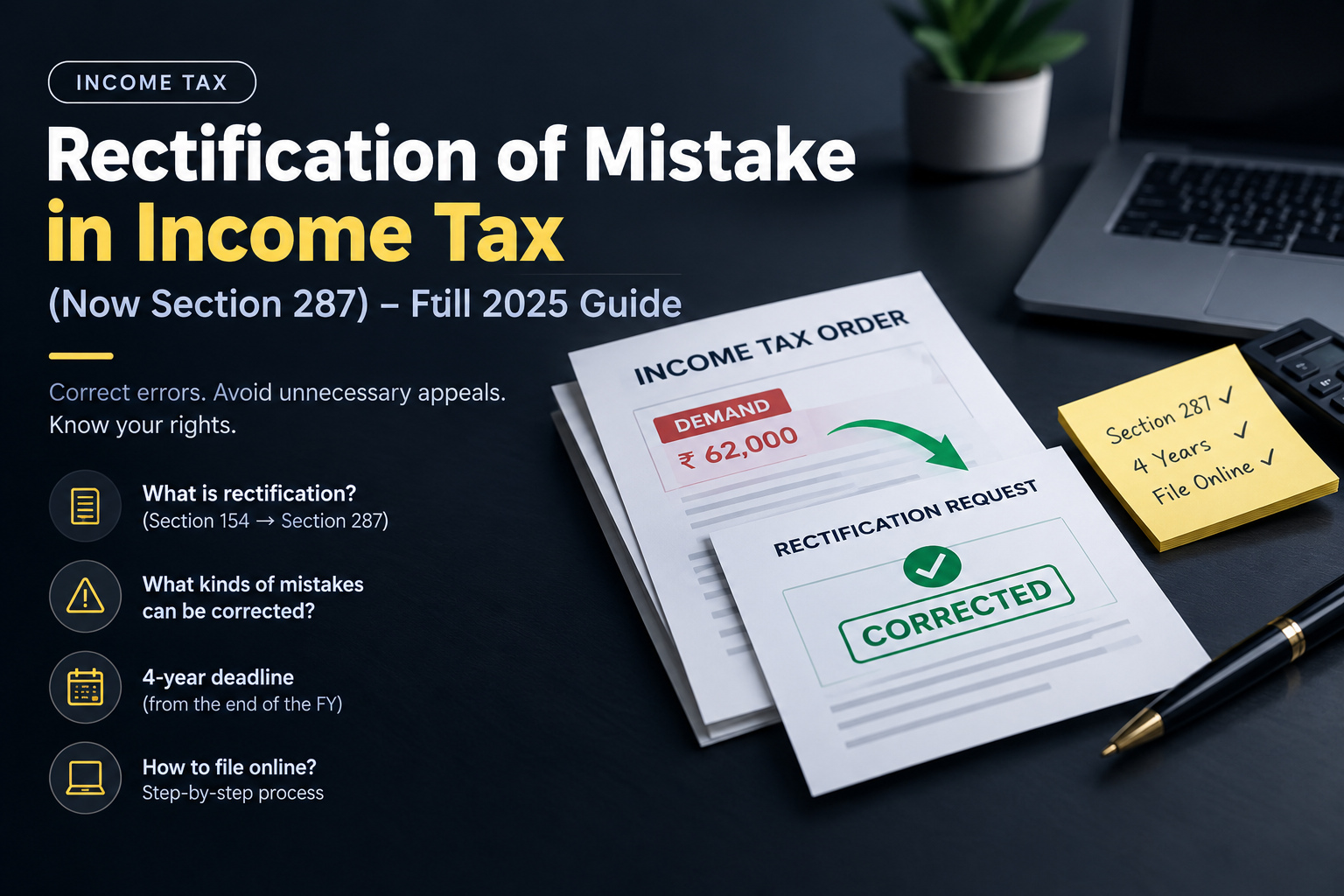
A client called me last month, genuinely panicked, because his intimation showed a demand of Rs 62,000 even though he’d paid every rupee of tax due. The reason was almost embarrassing in its simplicity: the processing system hadn’t picked up TDS of Rs 58,000 that was sitting right there in his Form 26AS. His first instinct was to file an appeal. That would have been the wrong move, and a slower one. What he needed was a rectification request.
This is probably the most under-used remedy in the entire income tax toolkit, mostly because people assume “rectification” means something complicated. It doesn’t. It’s a narrow, fast-moving correction mechanism for mistakes that are obvious from the record itself — no fresh evidence, no debate about facts, no arguing a point of law. Under the Income-tax Act, 1961, this lived in Section 154. Under the Income-tax Act, 2025, the same power now sits in Section 287, and reading the new section side by side with the old one, the drafting is almost a line-by-line carry-over.
What Counts as a “Mistake Apparent from the Record”
Section 287(1) and (2) let an income-tax authority amend an order it passed, an intimation (or deemed intimation) under Section 270(1) — that’s the processing intimation, equivalent to the old Section 143(1) — or an intimation under Section 399. The phrase that matters here is “mistake apparent from the record.” Courts have spent decades drawing the line on what that means, and in practice it boils down to errors that don’t need argument to spot:
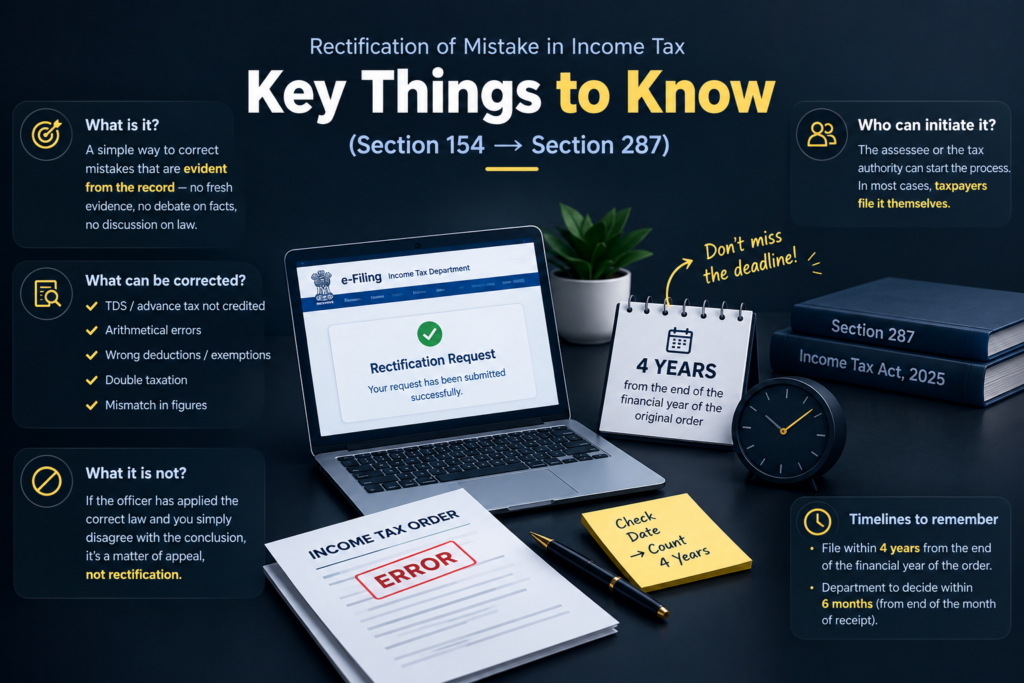
- TDS or advance tax actually paid but not credited, even though it shows up in Form 26AS or the AIS.
- A plain arithmetical slip — wrong addition, wrong tax computed on the correct income, an interest calculation under Section 234B or 234C that doesn’t match the figures on record.
- A deduction or exemption you were clearly entitled to and had claimed correctly, but which got disallowed by the processing software for no stated reason.
- Double taxation of the same income, say because a rectified TDS return and the original return both got picked up.
- A mismatch between the income assessed and the income actually computed in the body of the same order — the AO’s own figures contradicting each other.
What it is not: a case where the officer applied the correct law to the facts and you simply disagree with the conclusion. If the AO disallowed a deduction after looking at your documents and forming a view, that’s a dispute on merits, and rectification isn’t built for it — an appeal is. I’ve seen clients waste their four-year window filing rectification applications that were really appeal grounds in disguise, and by the time that gets rejected, the appeal deadline has often quietly passed too.
Who Can Set the Rectification Process in Motion
Section 287(3) allows the authority to act on its own motion, or the assessee can bring the mistake to its notice directly. Where the order in question was passed by the Joint Commissioner (Appeals) or Commissioner (Appeals) — the new-Act names for the first appellate authority — they can rectify it when the Assessing Officer points out the error to them. So the trigger can come from either side of the table; it’s just that in practice, almost every rectification that benefits a taxpayer gets filed by the taxpayer, because the department has little incentive to chase down errors that reduce its own collection.
The Four-Year Clock You Cannot Afford to Miss
This is where I see the most self-inflicted damage. Section 287(8) caps the window at four years from the end of the financial year in which the original order or intimation was passed — not four years from the date you noticed the mistake. If an intimation was issued in December 2022, the four years run from the end of FY 2022-23, meaning the deadline falls in March 2027, regardless of when you actually discover the TDS mismatch. I’ve had clients sit on a clearly wrong intimation for two years assuming “I’ll deal with it eventually,” only to come to me with barely a few months left on the clock. Don’t do that. The day you spot something off in an order, check the date of that order and count forward.
Once you do file, Section 287(9) puts the department on a clock too: the rectification application is supposed to be decided within six months from the end of the month in which it was received. In reality this timeline slips more often than it should, but it does give you something concrete to point to if a request sits unanswered for a year.
When the Correction Goes Against You
Not every rectification helps the taxpayer. Sometimes the department corrects its own order and the correction increases your liability or shrinks a refund you’d already banked on. Section 287(4) requires the authority to give you prior notice and a reasonable opportunity of being heard before making that kind of adverse amendment. A fair number of taxpayers ignore rectification notices on the (wrong) assumption that rectification only ever works in their favour. If you get one, read it — don’t bin it.
How to Actually File a Rectification Request
On the income-tax portal, this sits under e-Filing → Services → Rectification. You select the order you want corrected, choose the category of mistake — tax credit mismatch, reprocessing the return, exemption or deduction mismatch, or additional grounds, depending on what the dropdown offers for that order type — and attach your reasoning. Keep this ready before you start:
- A copy of the intimation or order you’re disputing.
- Form 26AS / AIS extract clearly showing the TDS or tax credit that wasn’t given.
- A one-page computation showing exactly where the system’s number diverges from the correct number.
- A short covering note, two or three lines, stating the mistake plainly rather than burying it in a long narrative.
The cleaner and more specific the request, the faster it tends to move. Vague requests that say “please correct my assessment” without pointing to a specific apparent error get stuck in a queue far longer than one that says, in effect, “TDS of Rs 58,000 reflected in 26AS under this TAN was not credited — see attached.”
Rectification, Revision, and Appeal Are Not the Same Remedy
This confusion costs people more than it should. Rectification under Section 287 (old 154) only touches mistakes apparent from the record. If you’re disputing the AO’s reasoning or the addition itself, that’s an appeal, governed now by Sections 356 and 357 (old Sections 246A and 249), filed before the Commissioner (Appeals). Separately, there’s revision — a power the Principal Commissioner or Commissioner holds to correct an order that’s erroneous and prejudicial to the interests of revenue, now under Section 377 (old Section 263), or to correct an order prejudicial to the taxpayer under Section 378 (old Section 264). Revision is a supervisory power exercised by a senior authority on its own initiative or on application; it’s broader in scope than rectification but has its own separate time limits and triggers, and it isn’t a substitute for an appeal you missed.
This exact distinction — when to rectify, when to appeal, and when revision is even available — is one of the recurring points of confusion I walk through module by module in the Income Tax Litigation Mastery course, because picking the wrong remedy doesn’t just fail; it often burns the clock on the remedy you actually needed.
What If Your Rectification Request Gets Rejected
A rejection order itself isn’t typically treated as independently appealable the way a fresh assessment is, but you’re not stuck. If the underlying order is still within its own appeal window, you can raise the same point as a ground in that appeal. If new facts come to light, you can file a fresh rectification application within the four-year window, provided it’s genuinely a different or better-evidenced mistake rather than the same request resubmitted. And in genuinely stuck cases, taxpayers have approached the High Court by way of a writ petition where the apparent mistake is undeniable and the department simply won’t act — though that’s very much a last resort, not a first move.
A Quick Real Example
Going back to the client I mentioned at the start: we filed a rectification request under the tax-credit-mismatch category, attached the 26AS extract and a one-line note, and the demand of Rs 62,000 was reversed within about seven weeks — no hearing, no appeal, no litigation cost. Compare that to what an appeal would have cost him in time and fees for a problem that was never actually in dispute. Knowing which door to knock on saved him both.
| Need help with a live litigation issue, not just the theory? The Income Tax Litigation Mastery (1961 + 2025 Act) course walks through rectification, revision, appeals and recovery proceedings with real orders and drafting templates, dual-mapped across both Acts. Check the course here → |
Frequently Asked Questions
- What is the time limit to file a rectification request under Section 154 (now Section 287)?
Four years from the end of the financial year in which the original order or intimation was passed — not four years from when you discovered the mistake. Check the date on the order itself and count from there.
- Can I file a rectification request against an intimation under Section 143(1) (now Section 270(1))?
Yes. Processing intimations are one of the most common documents corrected under this provision, especially for TDS credit mismatches and exemption or deduction errors that the processing system got wrong.
- What is the difference between rectification and revision of an income tax order?
Rectification (Section 287, old 154) only fixes mistakes that are obvious from the record, with no scope for argument. Revision (Sections 377 and 378, old 263 and 264) is a broader supervisory power exercised by a senior tax authority to correct an order that’s erroneous and prejudicial either to the revenue or to the taxpayer, and it isn’t limited to typo-level errors.
- How long does the department take to decide a rectification application?
Section 287(9) requires a decision within six months from the end of the month the application was received, though in practice this timeline can slip.
- Will rectification work if I simply disagree with an addition the Assessing Officer made?
No. If the AO applied the law correctly but reached a conclusion you disagree with, that’s a matter for appeal, not rectification. Rectification is only for errors apparent on the face of the record, not for re-arguing the case.